

MiMo-V2.6 is Xiaomi's September 2026 model series, and its organizing claim is that reinforcement learning, not another round of pretraining, is where the remaining gains are. Both released checkpoints are sparse mixture-of-experts models carrying a 1M-token context window, and both ship under the MIT license, so the weights are downloadable rather than locked behind an endpoint. The first-party model card was published on 2026-09-21; on 2026-09-22 Hugging Face listed 19 likes for the Pro checkpoint, 16 for Flash, and 18 for the distilled variant. It is a separate line from MiMo Code, which is Xiaomi's terminal agent rather than a model.
The Two Checkpoints
| MiMo-V2.6-Pro-RL | MiMo-V2.6-Flash-RL | |
|---|---|---|
| Parameters | 1.02T total, 42B activated | 309B total, 15B activated |
| Context | 1M tokens | 1M tokens |
| Inputs | Text, image, video, audio | Text, image, video, audio |
| License | MIT | MIT |
The Pro checkpoint is 70 layers with 384 routed experts, 8 of them activated per token, and a sliding-window-to-global attention mix (60 SWA layers, 10 global). A 681M-parameter MiMo ViT handles vision, a 308M AudioTokenizer plus a 127M patch encoder handle audio, and a 5-layer multi-token-prediction decoder speculates seven tokens ahead for parallel verification while decoding.
What Changed
Three choices separate this release from the usual open-weights drop:
- One mixed RL run instead of per-domain runs. Coding, general agents, visual tasks, and cybersecurity are trained in the same batch, with several harnesses mixed in, so the lab argues that strategies transfer to harnesses the model never saw.
- Asynchronous GRPO at large batch size. Each step uses 1,568 prompts by 16 rollouts, which the model card describes as billions of tokens per update.
- Groupwise agentic grading. Binary pass or fail cannot rank two passing answers, so the reward signal is scaled instead: an offline pass builds task-specific rubrics from contrasting rollouts, and an online pass moves advantage toward better trajectories. The stated goal is shorter paths and fewer tokens per task.
The series also ships MiMo-V2.6-Distill-Qwen-9B, a 9B student distilled on top of Qwen3.5-9B. That is the practical way to try MiMo behaviour without holding 1T parameters.
Benchmarks
Numbers below are the lab's own, from the model card, so treat them as the vendor's eval rather than a neutral ranking.
| Benchmark | Pro | Flash |
|---|---|---|
| DeepSWE v1.1 | 71.9 | 67.9 |
| Terminal Bench 2.1 | 89.9 | 87.6 |
| OSWorld-Verified | 82.0 | 80.8 |
| AutomationBench v1.0.6 | 53.1 | 52.3 |
| CyberGym | 94.0 | 95.1 |
For comparison inside the same table, the card lists Claude Opus 5 at 89.1 on Terminal Bench 2.1 and GPT-5.6 Sol at 88.8. On ProgramBench the gap is wider and runs the other way: 26.5 for Pro against 37.0 and 25.0 for the two closed models. Capability is uneven across domains, which is exactly what one mixed RL run would predict.
Running It
Deployment is documented for SGLang and vLLM. The reference SGLang command is a multi-node TP16, DP2, EP16 configuration with DeepEP as the MoE all-to-all backend, chunked prefill of 32768, and EAGLE speculative decoding, so this is data-centre hardware, not a single workstation. Flash is the tier to read first if you want to self-host. A hosted API and a browser studio are available from Xiaomi's own platform.
Limitations
- Serving cost is the real gate. The Pro tier needs multi-node tensor parallelism; the model card's own example spans two nodes.
- Vendor benchmarks. Every number above comes from the lab's own evaluation runs.
- Fresh, thin ecosystem. Quantisations, community fine-tunes, and third-party serving guides were still sparse in the first days after release.
- Modality coverage is not uniform. Omnimodal input does not mean equal strength across text, audio, and video.
FAQ
Is MiMo-V2.6 genuinely open?
Yes. The checkpoints are published with an MIT license, which is permissive enough for commercial use, and the weights are downloadable from Hugging Face and ModelScope.
Can I run the Pro checkpoint locally?
Not realistically on consumer hardware. 1.02T total parameters with 42B activated still requires a multi-GPU node. Use Flash, or the 9B distilled model, for anything short of that.
How is this different from MiMo-V2.5?
The series jump is mostly training-side: mixed RL across domains, much larger RL batches, and groupwise grading. The 1M context and omni input were already part of the V2 line.
Alternatives
- Qwen3.8-Flash-Next: a lighter open-weight route when you do not need omni input.
- LongCat 2.0: another long-context open model worth comparing on agent benchmarks.
- Bespoke Nimble: a small open model for cheap structured decisions rather than general agent work.
Conclusion
MiMo-V2.6 is a serious open-weights release aimed squarely at agentic work: 1M context, omni input, an MIT license, and an RL recipe that mixes domains in one run. The catch is arithmetic. Serving the flagship tier takes a multi-node cluster, so most teams will evaluate Flash or the 9B distilled model and treat Pro as a reference point for what the recipe can reach.
Comments
No comments yet. Be the first to comment!
Related Tools


Related Insights

Anthropic Subagent: The Multi-Agent Architecture Revolution
Deep dive into Anthropic multi-agent architecture design. Learn how Subagents break through context window limitations, achieve 90% performance improvements, and real-world applications in Claude Code.
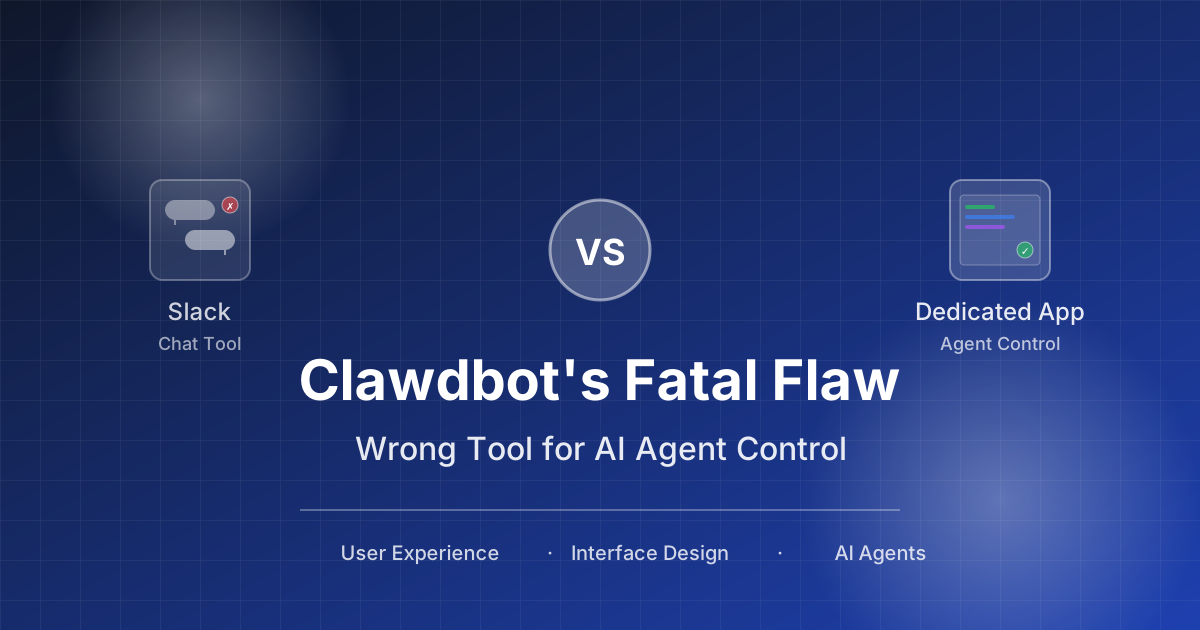
Stop Cramming AI Assistants into Chat Boxes: Clawdbot Picked the Wrong Battlefield
Clawdbot is convenient, but putting it inside Slack or Discord was the wrong design choice from day one. Chat tools are not for operating tasks, and AI isn't for chatting.

Grok Bot and Hermes Bot: one person finally gets a think tank and a secretariat
Grok Bot now ships with Cursor Pro+. Hermes Bot runs on a VPS. They are not smarter chat boxes. The think tank advises, the secretariat executes, and you still make the call.