

Qwen3.8-Max is Alibaba's current flagshship model and the first Max-tier Qwen to release open weights. It is a mixture-of-experts design with about 2.4 trillion total parameters but only 95 billion active per token, so it keeps a huge parameter budget while routing through a small fraction of experts on each forward pass. It accepts text, images, and video and returns text, and it is built on the Qwen 3.5 stack with a hybrid Gated-DeltaNet plus full-attention design and multi-token prediction. Alibaba previewed it at the World AI Conference on July 19, 2026 and shipped general availability on August 3.
Model Specifications
| Specification | Qwen3.8-Max |
|---|---|
| Architecture | Sparse MoE (hybrid Gated-DeltaNet + full attention, Qwen 3.5 stack) |
| Total parameters | 2.4T |
| Active parameters | 95B per token |
| Experts per layer | 512 (10 routed + 1 shared) |
| Modalities | Text, images, video in; text out |
| Context window | 262,144 native (256K), expandable to ~1.01M; up to 131K output |
| Release | Preview Jul 19, 2026; GA Aug 3, 2026 |
| Open weights | Qwen3.8-2.4T-A95B on ModelScope / Hugging Face (Aug 12, 2026) |
| API price | $2.00 / M input, $6.00 / M output |
Key Features
- First open Max: every previous Qwen Max model shipped closed and API-only. Qwen3.8-Max reversed that, putting the 2.4T checkpoint and a smaller companion model online from Aug 12.
- Very sparse MoE: only 11 of 512 experts fire per token, which keeps per-token compute low even though the full model needs a datacenter to hold.
- Native multimodal input: text, image, and video understanding for charts, screenshots, and documents.
- Long context: 256K native windows, extendable toward one million tokens for long-horizon and agentic reads.
- Agentic, reasoning-native tuning: built for coding, long-horizon work, and multimodal agents, with tool calling and structured output.
- Multiple API surfaces: OpenAI-, DashScope-, and Anthropic-compatible modes, and reachable through QwenCloud and aggregators like OpenRouter.
Use Cases
Who Should Use This Tool?
- Teams that want the open Qwen flagship and do not mind a hosted path for practical use.
- Long-context, agentic builders working with big codebases or long documents.
- Multimodal workflows that need to take screenshots, video, or scanned pages as input.
- Cost-conscious frontier shops that value the $2/$6 price against closed rivals.
Problems It Solves
- Access to a Max-class open model: the weights are now downloadable, correcting a years-long Qwen gap.
- Inference cost at scale: 95B active out of 2.4T makes per-token serving cheaper than the parameter count suggests.
- Local deployment reach: the 2.4T model realistically needs a datacenter, which is why the smaller Qwen3.8-27B sibling exists for desktop GPUs.
Pricing
| Path | Price |
|---|---|
| Open weights | Free to download on ModelScope / Hugging Face (custom Qwen license) |
| API input | $2.00 / 1M tokens |
| API output | $6.00 / 1M tokens |
| Aggregators | From about $1.65 in / $4.99 out on some third-party hosts |
The open weights give you the base model; the hosted qwen3.8-max adds production post-training. Self-hosting the 2.4T model is a cluster decision, not a workstation one: at 4-bit quantization it needs roughly 1.2 TB of VRAM.
Advantages & Unique Selling Points
Compared to Competitors:
- Versus Claude Opus / GPT-5.6: lands close to the frontier on vendor benchmarks at a third to a half of their price.
- Versus Qwen3.7-Max: cheaper ($2/$6 vs $2.50/$7.50) and adds image and video input, plus an open-weight release the previous generation never had.
- Versus DeepSeek / GLM open rivals: a much larger parameter budget with a hybrid attention design aimed at long context.
What Makes It Stand Out:
- The first Max-tier Qwen with open weights, at an aggressive price.
- Sparse activation makes it cheap to run at scale, though not cheap to own.
Important Caveat
Every headline benchmark is vendor-reported. Independent leaderboards, Artifactory Analysis runs, or a standardized SWE-bench result had not published a score at launch, and a neutral harness was reported to reverse some agentic numbers. Treat OSWorld-Verified 86.1, PaperBench 93.0, and Terminal-Bench 86.6 as Alibaba's own claims until verified elsewhere.
Getting Started
- API: point your client at QwenCloud or DashScope with model id
qwen3.8-max, or use it through an OpenAI- or Anthropic-compatible endpoint. - Open weights: download
Qwen3.8-2.4T-A95Bfrom ModelScope or Hugging Face if you have datacenter GPUs. - Self-host: for a single consumer GPU, use the Apache-2.0 Qwen3.8-27B instead.
- Pair it with Qwen Code: the open-source terminal coding agent is tuned for Qwen models.
Frequently Asked Questions
Is it multimodal?
Yes. Text, image, and video in, text out.
What is the real context?
Native 256K, expandable to roughly 1.01M in a mode whose quality tradeoffs Alibaba has not fully documented.
Can I run it locally?
Not practically. The 2.4T model needs a datacenter-class cluster. Prefer the 27B companion for local work.
What license?
The weights use a custom Qwen license that is near-MIT with limits worth reading before commercial use. It is not Apache 2.0.
Alternatives
- Qwen3.8-27B: dense Apache-2.0 companion that fits one consumer GPU.
- Qwen3.8-Flash-Next: the cheap architecture preview of Qwen4, about one-twelfth the price.
- GLM-5.3-Flash: another recent open-weight cost-efficiency release, 320B / 18B active, MIT.
Tips & Best Practices
- Read the license file on the ModelScope repo before shipping anything commercial; "custom" is not the same as permissive.
- Do not assume 1M context out of the box; the native window is 256K.
- Benchmark on your tasks: the vendor agentic numbers have been reported to shrink under a neutral harness, so re-run them on your own workload.
Conclusion
Qwen3.8-Max is Alibaba's largest open Qwen ever: a 2.4T MoE with 95B active, multimodal input, 1M-class context, and the first Max-tier open weights the company has shipped, priced at $2/$6 per million tokens. For builders who want a frontier-scale open model without a closed provider, it is the headline option of the month. Start at the Qwen blog or the QwenCloud model page.
Comments
No comments yet. Be the first to comment!
Related Tools


Related Insights

Claude Code account precautions: before you spend $200, do these six things
Gmail plus Apple private sign-in, Cliproxy residential routing for CC and emulators, IP/DNS checks, gradual upgrades, and history-preserving sign-out. Includes a profile and script.

Create a US Apple Account: switch the App Store, keep iCloud signed in
Register with your own email and phone, complete store setup, and redeem a US gift card purchased with Alipay. Diagrams explain iCloud, purchase accounts and private Apple sign-in.
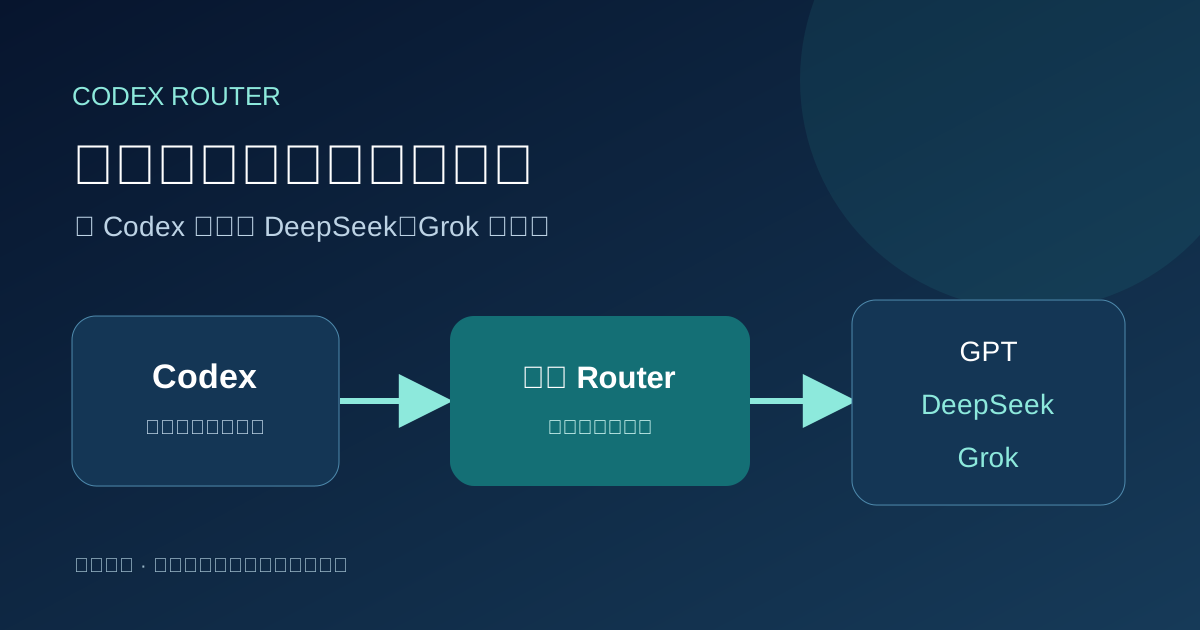
Running low on ChatGPT Codex quota? Switch to DeepSeek or Grok inside Codex
Codex Router lets you keep your Codex workspace while using DeepSeek, Grok, and other external models. A plain-English guide to routing, quotas, and network access.