

Supra2-IMG is SupraLabs' attempt to answer a specific question: how small can a text-to-image model be before the output stops being useful? The first-party model card was published on 2026-09-21 and the weights landed under the Apache-2.0 license; Hugging Face listed 56 likes on 2026-09-22. The model is a 104.1M-parameter diffusion transformer trained entirely from scratch, which puts it in a different weight class from every hosted image model it will inevitably be compared to.
Specifications
| Value | |
|---|---|
| Architecture | Tiny diffusion transformer (DiT) |
| Parameters | 104.1M |
| Text encoder | Frozen Flan-T5-Base (128 tokens) |
| VAE | SD-VAE-FT-MSE |
| Resolution | 256 x 256 |
| Latent size | 32 x 32, patch 2 |
| License | Apache-2.0 |
The published config is a 14-layer model with D_MODEL 576, 9 attention heads, head dimension 64, and an MLP ratio of 4.0. The unconditional embeddings are stored inside the checkpoint rather than computed on the fly, which keeps the inference script short.
How It Was Trained
The training run is the headline. Supra2-IMG was trained for 10 epochs on the full LucasFang/FLUX-Reason-6M dataset, 5.6M images after the lab filtered prompts by falling back through caption composition, entity, text, style, and imaginative fields in that order. The whole job ran on a single Nvidia H100 SXM 80GB pod for nine hours including data preparation, with a 2.5TB disk. Sampling settings are fixed and disclosed: seed 0, 50 steps, cfg 3.0, and the same settings for every published sample.
Running It
There is no pipeline wrapper to install. Download inference.py from the model repository, then run it against the checkpoint:
mkdir Supra2-IMG && cd Supra2-IMG
wget https://huggingface.co/SupraLabs/Supra2-IMG/resolve/main/inference.py

python inference.py \
  --prompt "a sea jellyfish floating in the pitch-black ocean depths" \
  --seed 0 --cfg 3.0 --steps 50 --n 1 --out jellyfish.png
The script pulls the frozen Flan-T5-Base tokenizer and encoder plus the SD-VAE-FT-MSE decoder, then runs Euler flow sampling for the requested number of steps. The checkpoint file is roughly 416MB, so the download is trivial compared with the multi-gigabyte weights that most image models ship.
What It Is Good For
- Learning how DiT text-to-image training works end to end. The data pipeline, config, and inference script are all readable in one sitting.
- CPU and low-end GPU experiments. At 104M parameters the model is small enough to generate on modest hardware, which is unusual for this category.
- Fixed-budget prototypes. If you need a 256x256 thumbnail generator you can embed and retrain, the size is the feature.
Limitations
- 256 x 256 only. This is not a model for print, product shots, or anything that needs detail.
- "SOTA for its size" is the lab's framing. No neutral third-party ranking of models at this scale exists.
- No product surface. There is no hosted playground, no API, and no app; the deliverable is a Python script.
- Small text encoder, short prompts. Flan-T5-Base caps prompt handling at 128 tokens, so long, compositional prompts will degrade.
- Vendor-run evaluation. Sample grids come from the lab, and a 9-hour single-GPU budget buys you a specific trade-off between cost and sharpness.
FAQ
Is Supra2-IMG free for commercial use?
The model card declares Apache-2.0, which is permissive. Note that the training corpus has its own provenance, so review the dataset terms if the output matters commercially.
Can it run without a GPU?
The lab reports generating an image in roughly 20 seconds on CPU and about 2 seconds on a GPU. Treat those as the project's own timings.
How does it compare to a hosted model?
It does not, on quality. Compare it to other small open models, not to a frontier API. For a different open approach to the same problem, see Qwen-Image-2.1.
Alternatives
- Qwen-Image-2.1: a far larger open-weights model that also handles editing, at a much higher hardware cost.
- Nano Banana: a hosted option when you want quality rather than control.
- GPT Image 2: the closed endpoint to compare against on prompt following.
Conclusion
Supra2-IMG is a small, honest, fully reproducible experiment. Nine hours on one H100 and a 104M-parameter DiT is nowhere near what a hosted image model can do, but that is the point: the whole recipe fits in a repository you can read, retrain, and run on hardware you already own. Try it if you want to understand tiny diffusion transformers, not if you need production images.
Comments
No comments yet. Be the first to comment!
Related Tools


Related Insights

Grok Bot and Hermes Bot: one person finally gets a think tank and a secretariat
Grok Bot now ships with Cursor Pro+. Hermes Bot runs on a VPS. They are not smarter chat boxes. The think tank advises, the secretariat executes, and you still make the call.
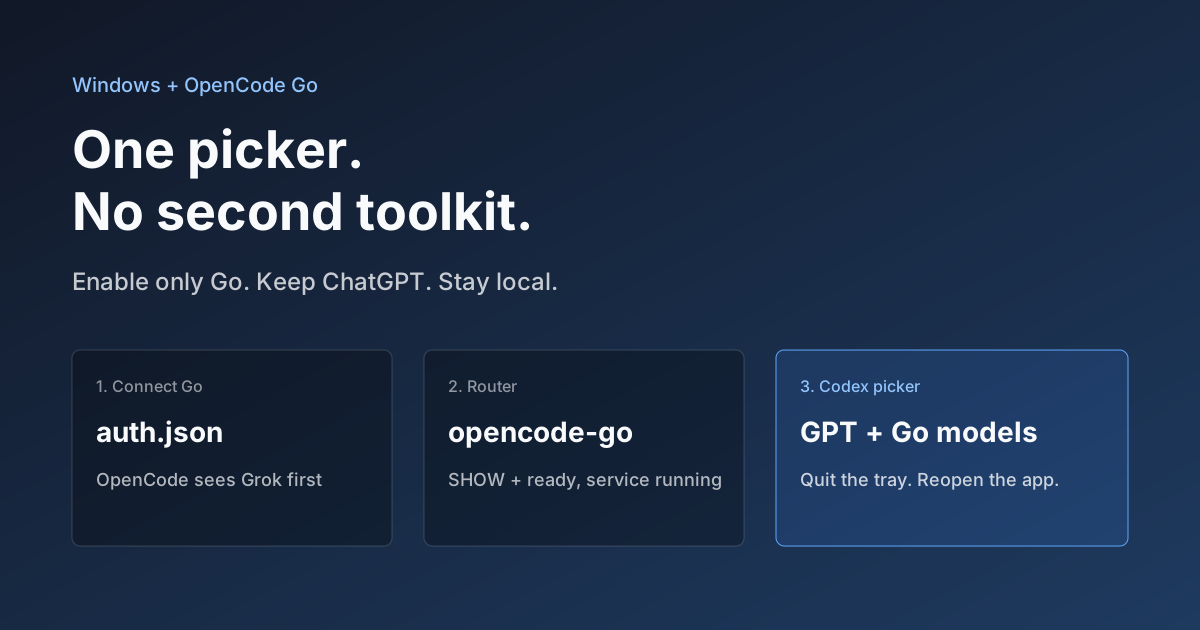
Hook OpenCode Go into Codex on Windows. Do Not Open a Second Toolkit.
A ChatGPT-signed Codex desktop app still shows mostly GPT in the picker. On Windows, enable only OpenCode Go and the Grok, GLM, Kimi, DeepSeek, and MiniMax models you already pay for appear in the same selector. Keys stay local. Native GPT stays put.
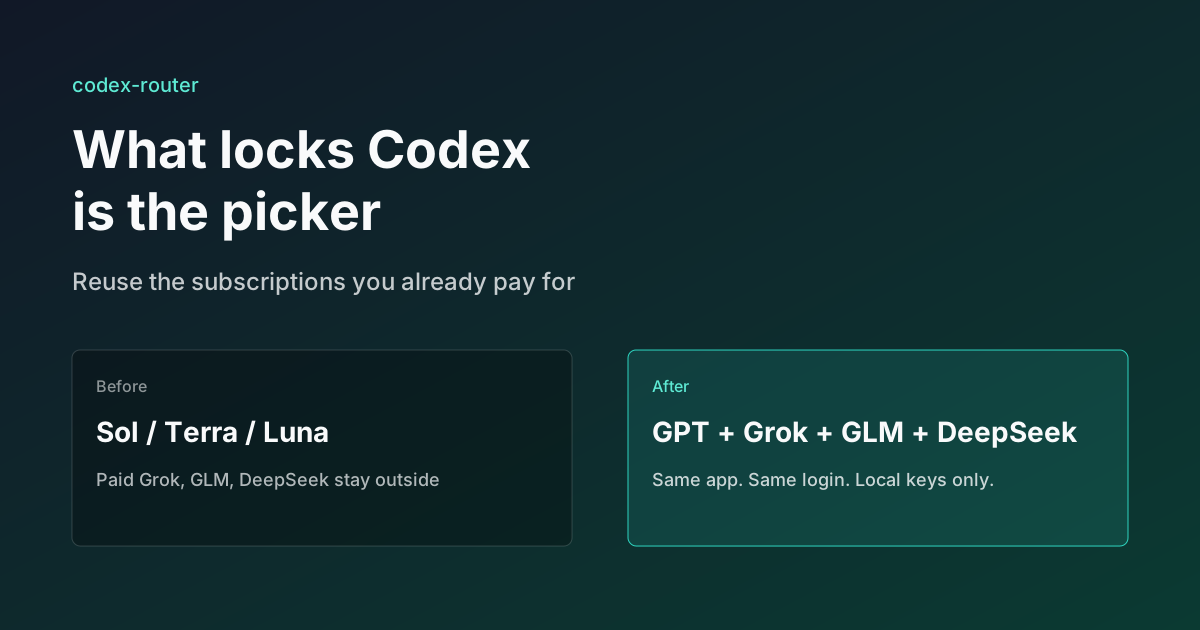
What Locks Codex Is the Picker, Not the Models
You already pay for OpenCode Go, Grok, and Z.ai, but the Codex picker still shows mostly GPT. The community project codex-router does not teach another install ritual. It puts subscriptions you already bought back into the selector, keeps keys on the machine, and leaves native GPT alone.