

Ponytail is an open-source agent skill that pushes your coding agent to write only what the task actually needs. Its pitch is a character every team recognizes: the quiet senior dev who reads fifty lines, says nothing, and rewrites them as one. The skill installs into Claude Code, Codex, OpenCode, Gemini CLI, Pi, and many other harnesses, and the lazy senior dev effectively becomes a ruleset the agent cannot drift away from. It is meant to counter the biggest complaint about AI assistants: over-engineering, bloated diffs, and tokens burned on problems that did not exist.
Key Features
- The lazy senior dev ladder: before writing anything, the agent stops at the first rung that holds. Does this need to exist (YAGNI), is it already in this codebase, does the stdlib do it, does the browser or platform already support it, is a dependency already installed, can it be one line, and only then the minimum that works.
- Intensity levels:
/ponytail lite|full|ultrasets how aggressive it is, withfullas the default.ultradeletes before it adds. - Dedicated commands:
/ponytail-reviewhands back a delete-list for the current diff,/ponytail-auditscans the whole repo,/ponytail-debtcollects deferred shortcuts,/ponytail-gainshows the measured impact board, and/ponytail-helpis the quick reference. - Broad harness support: Claude Code, Codex, Devin CLI, OpenCode, Gemini CLI, Pi, Swival, Hermes Agent, Qoder, Grok Build, and more. Instruction-only hosts (Cursor, Windsurf, Cline, Copilot) still load the always-on ruleset even without the slash commands.
- Always-on: the skill auto-loads AGENTS.md from the repo root, so a checkout works with zero setup.
Use Cases
Who Should Use This Tool?
- Developers tired of huge AI diffs who want the agent to write less without losing correctness.
- Cost-sensitive teams that pay per token and want a measurable cut in spend and latency.
- Teams running multiple agents that all trend toward over-building the same way.
- Reviewers who use
/ponytail-reviewas a second pass before merge.
Problems It Solves
- Unnecessary abstractions: no interface with one implementation, no factory for one product, no config for a value that never changes.
- Boilerplate and scaffolding for later: the skill removes code written for a future that may never come.
- Token and cost bloat: measured against a no-skill baseline, ponytail cut lines of code by about 54%, tokens by about 22%, cost by about 20%, and wall-clock time by about 27% in the project's agentic benchmark, while keeping every safety guard.
Pricing
| Plan | Price | Features |
|---|---|---|
| Open source | Free | MIT-licensed skill, all commands and intensity levels |
Ponytail is entirely free and MIT-licensed. The only cost is what you already pay your agent provider, and the point is to reduce that.
Advantages & Unique Selling Points
- One arm cuts every metric: in the maintained agentic benchmark (real Claude Code sessions editing a real FastAPI + React repo), it was the only variant that reduced LOC, tokens, cost, and time while staying 100% safe.
- It is a skill, not a prompt: the ruleset keeps enforcing itself on every response instead of drifting after a few turns.
- Lazy without negligence: it never removes validation, error handling, security, accessibility, data-loss protection, or anything explicitly requested.
Getting Started
- Install: pull the repo (or the packaged skill) into your agent's skills directory.
- Use: run any coding task; the skill applies automatically. Adjust intensity with
/ponytail lite|full|ultra. - Review: run
/ponytail-reviewon the current diff or/ponytail-auditon the whole repo.
Frequently Asked Questions
Does it make the agent careless?
No. It is lazy about the solution, never about understanding. It traces every file the change touches before choosing a rung, and never cuts safety guards.
Which agents work with it?
Skill-capable hosts get the commands; instruction-only hosts (Cursor, Windsurf, Cline, Copilot, Kiro) still get the always-on ruleset without the slash commands.
Do the benchmark numbers hold for my model?
The vendor numbers are measured on Haiku 4.5 against a no-skill baseline. The README itself notes a terse reasoning model can go the other way, so re-run the benchmark on your own model and workload.
Alternatives
Comments
No comments yet. Be the first to comment!
Related Tools


Related Insights

Skills + Hooks + Plugins: How Anthropic Redefined AI Coding Tool Extensibility
An in-depth analysis of Claude Code's trinity architecture of Skills, Hooks, and Plugins. Explore why this design is more advanced than GitHub Copilot and Cursor, and how it redefines AI coding tool extensibility through open standards.

Claude Code account precautions: before you spend $200, do these six things
Gmail plus Apple private sign-in, Cliproxy residential routing for CC and emulators, IP/DNS checks, gradual upgrades, and history-preserving sign-out. Includes a profile and script.
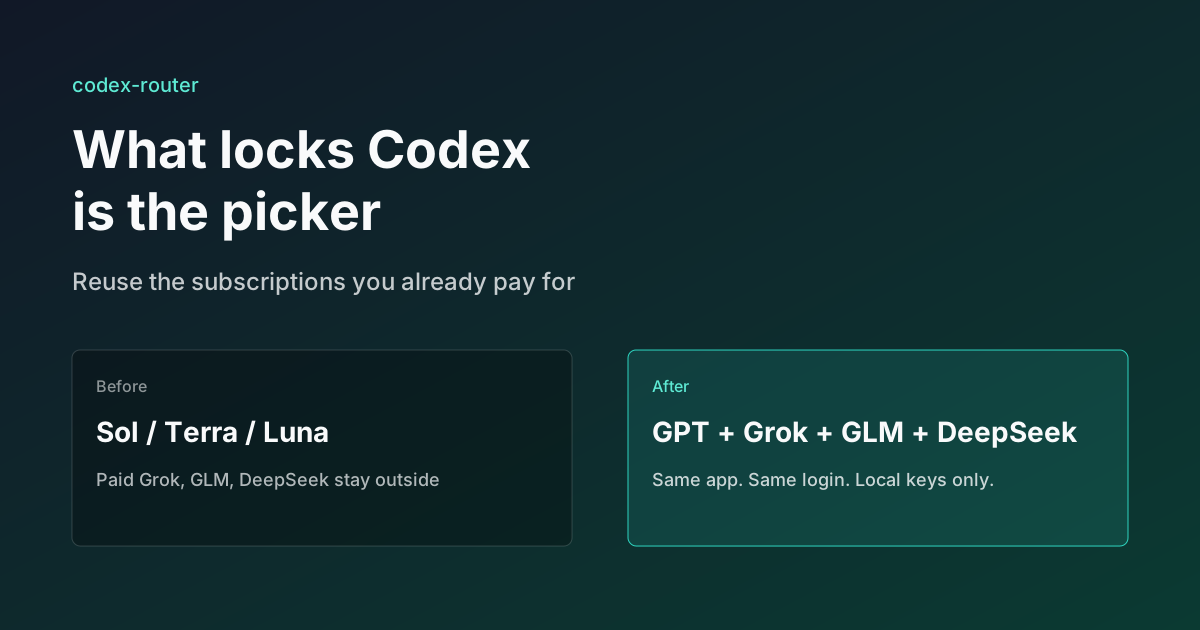
What Locks Codex Is the Picker, Not the Models
You already pay for OpenCode Go, Grok, and Z.ai, but the Codex picker still shows mostly GPT. The community project codex-router does not teach another install ritual. It puts subscriptions you already bought back into the selector, keeps keys on the machine, and leaves native GPT alone.