
Muse Glimmer is Meta's open-weight 30B parameter agentic multimodal model, released on August 10, 2026 under the Apache 2.0 license. Distilled from Meta's larger Muse Spark model, it is specifically engineered for always-on local agent workflows: planning, tool calls, result checking, and failure recovery. It accepts interleaved text and images, runs on a single consumer GPU (24GB target with 4-bit quantization), and needs no network call, making it a credible default for private local coding agents.
Core Features
- Agent-native training: Built around the agent loop (plan, call tools, interpret results, recover from failure), not just chat.
- Multimodal input: A ~1.8B ViT-G/14 perception encoder accepts screenshots, charts, and documents alongside text, up to 4,096 visual tokens per image.
- Runs locally: Dense 30B model with ~29.6B total parameters, 131,072+ token context, Apache 2.0 license, no network required.
- 24GB target: 4-bit quantized builds fit the language model under 20GB, leaving room for KV cache, vision encoder, and drafter in a 24GB/32GB envelope.
- DFlash speculative decoding: A 2.56B block-diffusion drafter proposes 16 tokens per forward pass, verified in parallel; up to 3.1x decode speedup on RTX 5090.
- Day-0 ecosystem: Support in transformers, llama.cpp, vLLM, Ollama, LM Studio, SGLang, MLX, and ExecuTorch at launch.
Model Specifications
| Specification | Muse Glimmer 30B |
|---|---|
| Parameters | ~29.6B dense (incl. ~1.8B vision encoder) |
| Context | 131,072+ tokens |
| Modality | Text + image input; text output |
| Languages | 100+ |
| License | Apache 2.0 (weights, quantizations, drafter, encoder) |
| Hardware | 24GB/32GB VRAM with 4-bit quant; 55GB+ at full BF16 |
Benchmark Highlights
- BionicBench (LM Studio, independent): 83.3% task completion vs 77.7% for Gemma 4 31B and Qwen3.6-27B.
- Agentic wins: Leads comparators on MCP Atlas, DeepSearch QA, and SWE-Bench Pro.
- Tradeoffs: Trails Qwen3.6-27B on OSWorld-Verified, TerminalBench 2.1, and SkillsBench for long multi-hour sessions.
Use Cases
- Private local coding agents: Run tool-use agents fully offline with no data leaving the machine.
- Document and screen understanding: Agents that read screenshots, charts, and documents while calling tools.
- Personal assistants: Claw/Hermes-style setups that need long-horizon context and multimodal perception.
- Cost-sensitive pipelines: LLM-as-a-judge and repetitive evaluation workloads are cheap to run locally.
Advantages
- Truly local agentic: A 30B multimodal agent that fits one consumer GPU, with a fully permissive license.
- Integrated stack: Quantization, speculative decoding, and runtimes designed together rather than bolted on.
- Meta ecosystem: Official GGUF, ExecuTorch, and transformers support plus named hardware partners (AMD, Arm, Dell, Intel, NVIDIA).
Tips
- Start with K-Quant-17GB on a 24GB card: Validate text-only performance first, then add vision and DFlash while watching memory headroom.
- Use DFlash in agent loops: Speculative decoding matters most for long reasoning chains and multi-step tool calls.
- Pick Qwen3.6-27B for multi-hour terminal sessions: Glimmer shines at scoped tool use; its rivals lead on very long autonomous runs.
Conclusion
Muse Glimmer gives local-agent developers their first realistic default: a permissively licensed, multimodal, agentic 30B model that runs on hardware they already own. If you want private, always-on coding and tool-use agents without cloud dependence, it is the strongest open-weight option in its class today.
Related: Claude 3.5 Sonnet and Claude 3 Haiku. Hub: models.
Comments
No comments yet. Be the first to comment!
Related Tools


Related Insights
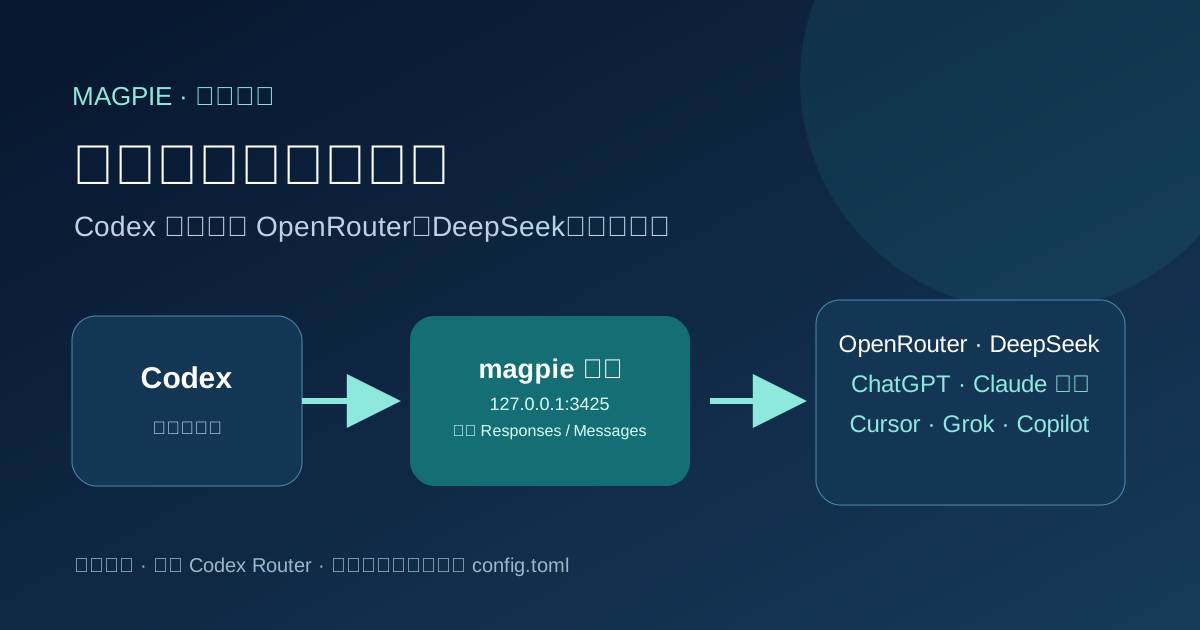
Codex on any model: magpie makes Codex Router unnecessary
magpie is a free, open-source menu bar app that runs a local gateway and puts OpenRouter, DeepSeek and your ChatGPT, Claude, Cursor, Grok and Copilot subscriptions right into Codex's own model picker, with one click and no Codex Router.
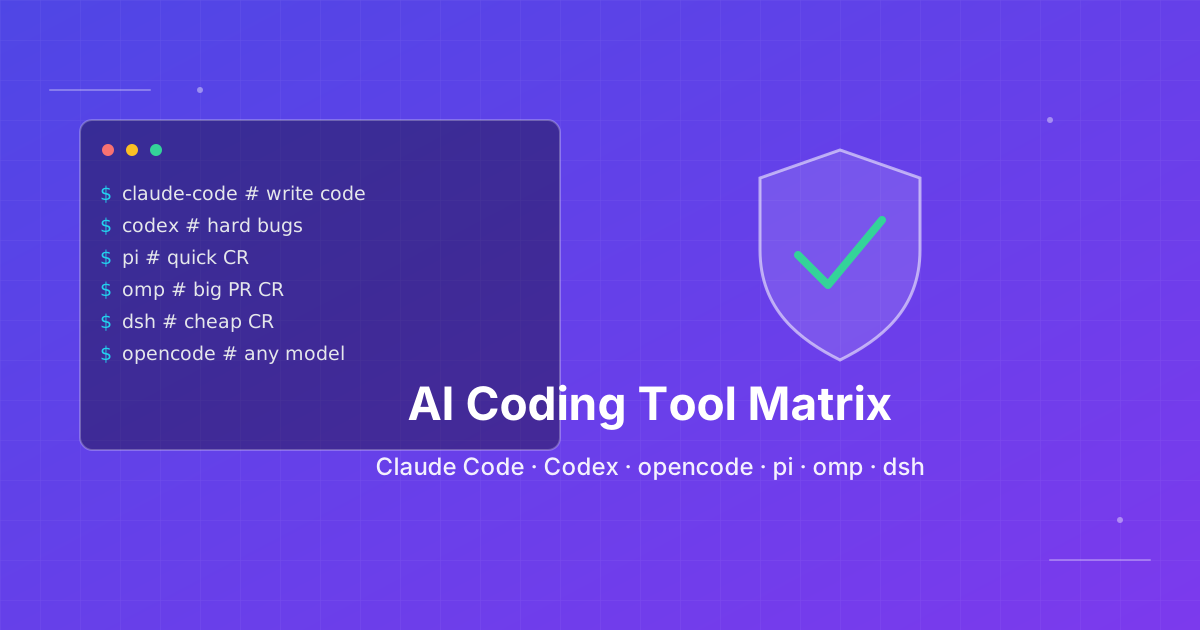
Seven AI Coding CLIs, Six Months: No Matter How Strong the Model, Work Needs Supervision
Claude Code, Codex, opencode, pi, omp and DeepSeek Harness all have personalities. After six months of deep use I run a division of labor: pi for the fastest cheapest reviews, omp for complex PRs, DeepSeek Harness on V4 Flash for high-frequency low-cost review, and Claude Code, Qoder and Cursor for writing. No matter how strong the model, work needs supervision — ideally from an independent third party.

Anthropic Subagent: The Multi-Agent Architecture Revolution
Deep dive into Anthropic multi-agent architecture design. Learn how Subagents break through context window limitations, achieve 90% performance improvements, and real-world applications in Claude Code.