

Archify is an agent skill that compiles a typed JSON IR into architecture, workflow, sequence, data-flow, and lifecycle diagrams as one HTML file. The repo tt-a1i/archify is JavaScript, MIT, created 2026-04-15. On 2026-09-18 GitHub listed 65,850 stars and 4,399 forks. The project page is tt-a1i.github.io/archify. 65,850 stars is a heat signal, not traffic. README that day named development version v2.17.0-dev.1.
Agents write JSON. Archify validates schema, layout, routes, and label clearance, then atomically replaces the last good HTML. It is not a Mermaid theme and not a drawing editor. Compare Mermaid Visualizer if you wanted Markdown diagrams, or Excalidraw Diagram if you wanted a sketch. Hosts include Claude Code, Codex CLI, Cursor, and OpenCode.
Install: npx skills add tt-a1i/archify -g. No repository is required; you can describe a system in chat.
Key Features
- Five diagram types: architecture, workflow, sequence, data flow, lifecycle. Optional architecture
deployment-ownershipfails closed when owners or regions are missing. - Deterministic HTML/SVG: four visual presets, dark/light, finite motion that respects
prefers-reduced-motion. Export PNG, SVG, WebM, and 1200x630 share cards. - Architecture Delta: compare two validated snapshots as Before / Delta / After with added, removed, changed, moved, and rerouted facts.
node archify/bin/archify.mjs compare ... - Grounded viewer: search nodes, trace authored upstream/downstream reach and exact routes, compare roles, play named stories. It does not invent topology or claim runtime impact.
- Source evidence on request: architecture nodes can open Git-verified files and line ranges pinned to one public commit. Ordinary artifacts stay source-free.
- Last-good preview: optional loopback desktop watch reloads only after every gate passes.
Limitation: automatic Mermaid parsing, general auto-layout, hosted sharing, and WYSIWYG editing are out of scope. Claude.ai upload depends on Node in the sandbox. An optional update check may GET a stable manifest (IP and time only, per README); set ARCHIFY_UPDATE_CHECK_DISABLED=1 to disable it.
Use Cases
- Explain a runtime path from a repo: 8-12 components, one primary path, trust boundaries.
- PR architecture review: Delta before merge, without claiming merge safety.
- Cache-miss or auth sequence that has to stay faithful to authored calls.
Skip it if you only need a quick Mermaid flowchart in a Markdown file.
Pricing
| Piece | Price | Notes from first-party pages 2026-09-18 |
|---|---|---|
| Skill + renderer | $0 | MIT. npx skills add tt-a1i/archify -g. About 65,850 stars. |
| Host | Your agent plan | Claude Code, Codex, Cursor, OpenCode, or Raven ZIP install. |
| Sponsors | N/A | README lists supercode.sh and EverMind Raven. Not a price. |
Getting Started
npx skills add tt-a1i/archify -g- In chat:
Use Archify to draw: Browser -> API -> Redis cache -> PostgreSQL fallback. - Refine:
add Redis,highlight the rollback path. - For a repo: ask for 8-12 core components and one primary path, detail in cards not extra edges.
First-party start: the project page, SKILL.md, and Proof Lab.
Frequently Asked Questions
Is this Mermaid?
No. Typed JSON IR plus a renderer. Mermaid parsing is intentionally out of scope.
Does the viewer invent extra edges?
The README says focus, reach, routes, lenses, and stories reuse authored nodes and relationships.
Can I run it without an agent?
Yes. node archify/bin/archify.mjs validate|preview|deliver ... after cloning. Node ^22.19.0 || >=24.0.0 is listed for the DeepSeek Harness plugin; confirm current README for the core CLI.
Alternatives
- Mermaid Visualizer: text to Mermaid, Obsidian/GitHub friendly.
- Excalidraw Diagram: hand-drawn boards, not validated IR.
- Claude Code: a host that can load Archify.
- OpenCode: another host listed in the agent switcher.
Tips
- Put supporting detail in cards. Extra edges make the layout worse.
- Use
validate --json/deliver --jsonand only applysupportedFixes. - Disable the update check if you do not want the reminder GET.
Conclusion
Archify is for diagrams you can present and still trust: typed source, gates before replace, one HTML file. Use it when a Mermaid sketch is not enough. Stay on Mermaid if you only need a flowchart in a README.
Comments
No comments yet. Be the first to comment!
Related Tools


Related Insights
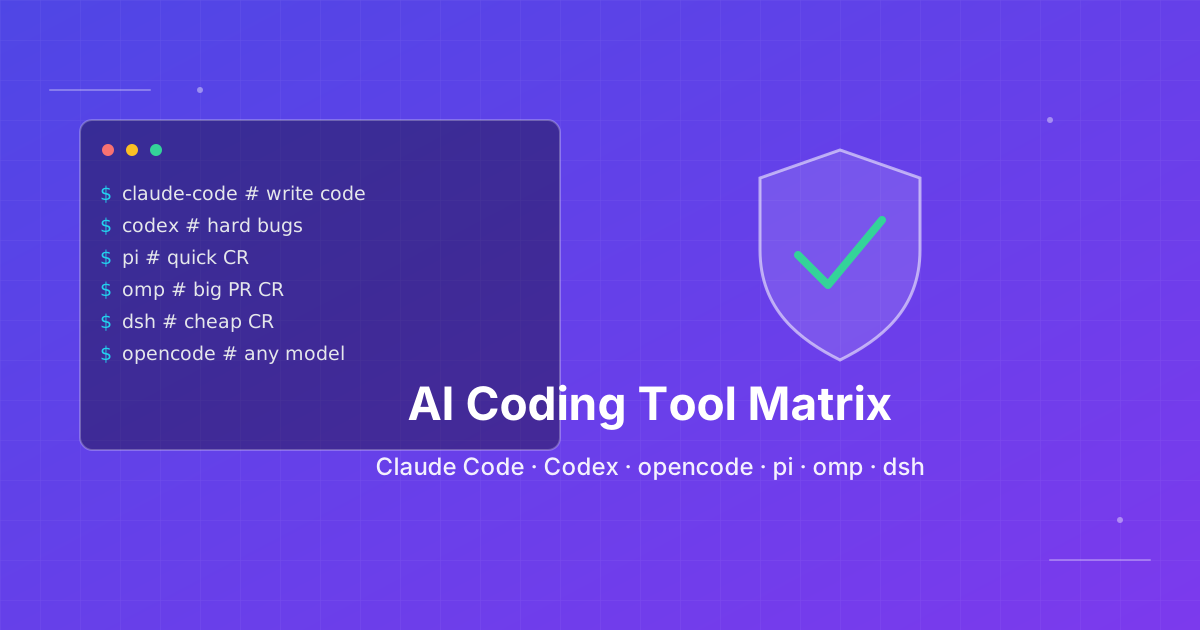
Seven AI Coding CLIs, Six Months: No Matter How Strong the Model, Work Needs Supervision
Claude Code, Codex, opencode, pi, omp and DeepSeek Harness all have personalities. After six months of deep use I run a division of labor: pi for the fastest cheapest reviews, omp for complex PRs, DeepSeek Harness on V4 Flash for high-frequency low-cost review, and Claude Code, Qoder and Cursor for writing. No matter how strong the model, work needs supervision — ideally from an independent third party.

Skills + Hooks + Plugins: How Anthropic Redefined AI Coding Tool Extensibility
An in-depth analysis of Claude Code's trinity architecture of Skills, Hooks, and Plugins. Explore why this design is more advanced than GitHub Copilot and Cursor, and how it redefines AI coding tool extensibility through open standards.

Anthropic Subagent: The Multi-Agent Architecture Revolution
Deep dive into Anthropic multi-agent architecture design. Learn how Subagents break through context window limitations, achieve 90% performance improvements, and real-world applications in Claude Code.