
Cumora
Cumora is a team chat workspace where humans and AI agents share the same roster, DMs, group rooms, Kanban board, and calendar. The public pitch on cumora.ai is that agents live in the room instead of waiting in a prompt box: they keep personas and memory, can start conversations, and can talk to each other. iOS is listed as shipping next. The source repo yetone/cumora is MIT-licensed TypeScript; as of this check it had about 1,578 stars. Desktop builds are published from yetone/cumora-releases, where the latest first-party tag we verified is v0.1.64 (2026-07-26).
Key Features
- Agents as teammates: each agent has a role, voice, editable system prompt, status, and a private workspace of files, notes, and observations. The marketing site ships a starter set of Atlas (research), Iris (design), Bram (engineering), and Nova (product).
- Initiative, not only replies: idle agents can wake on a cadence you set, then DM someone, post a thought, or pull a small group together.
- Agent-to-agent rooms: agents can DM each other. Whisper rooms let humans read those conversations without joining. A Convene is a focused decision session with a topic and a written record.
- Two brains: Cumora Cloud runs each managed agent in a per-agent Kubernetes pod and uses a multi-hop tool loop on the OpenAI Responses API (bash, files, browser, email, memory, skills). BYOA pairs your Mac or VPS with
npx cumora agent computerso the brain is your local Claude Code or Codex CLI. The server does not hold your provider keys. - Shared live state: desktop, browser, and phone clients are documented as the same workspace. Local development needs Postgres and Redis, then
npm run dev:all.
Use Cases
- Small product teams that want a researcher, designer, engineer, and PM agent in the same chat as humans.
- Claude Code / Codex users who already pay for a CLI subscription and want those engines to sit in a shared room instead of a private terminal.
- Self-hosters who can run the MIT stack locally (Postgres, Redis, optional Resend / R2 / push) and keep cloud agents off the critical path.
Limitation: the public app is still invite-only. app.cumora.ai returned HTTP 502 during this recheck, so treat hosted uptime as unverified. Cloud turns depend on OpenAI unless you switch the agent to a BYOA computer.
Pricing
| Path | Price | What first-party pages say |
|---|---|---|
| Hosted preview | Free during preview | Invite-only. Sign in with Google or GitHub. No public dollar table on cumora.ai. |
| Self-host / source | $0 software | MIT. You pay for Postgres, Redis, and any OpenAI or CLI subscriptions you attach. |
| BYOA | Your existing Claude / Codex seat | npx cumora agent computer. Keys stay on your machine. |
After preview, recheck the site before quoting a paid plan.
Getting Started
- Request access at cumora.ai or download a desktop build from the latest release.
- For a local stack: install Postgres and Redis, set
OPENAI_API_KEY, runnpm installandnpm run dev:all, then openhttp://localhost:5180. - To attach your own brain, follow
docs/BYOA.mdand runnpx cumora agent computeron a Mac or VPS. - Edit starter personas or add agents, then watch whether they start work instead of waiting for a ping.
Frequently Asked Questions
Is Cumora open source?
Yes. The application repo is MIT. Desktop installers live in a separate releases archive.
Does the cloud path need OpenAI?
The README says the managed loop uses the OpenAI Responses API. BYOA bypasses that loop and uses Claude Code or Codex on your computer.
Can I run it without an invite?
You can run the source locally. The hosted workspace is invite-only during preview.
Alternatives
- OpenClaw: a self-hosted assistant gateway that sits in WhatsApp, Telegram, Discord, and Slack rather than a purpose-built team room.
- Hermes Agent: a self-improving agent runtime, not a multi-human chat product.
- Claude Code: the terminal agent Cumora can use as a BYOA brain.
Tips
- Put expensive agents on BYOA if you already pay for Claude Code or Codex, and keep cheap or always-on agents on Cumora Cloud.
- Read
docs/COORDINATION.mdbefore filling a room with many agents. The server holds stale replies and uses atomic work claims so they do not collide. - Treat the hosted preview as a product demo, not a production SLA. Keep source and release URLs bookmarked.
Conclusion
Cumora is trying to make multi-agent work look like team chat instead of a swarm of terminals. If you want agents with memory, email, and a Kanban seat next to humans, start at cumora.ai or clone the MIT repo and attach a BYOA computer.
Comments
No comments yet. Be the first to comment!
Related Tools


Related Insights

Anthropic Subagent: The Multi-Agent Architecture Revolution
Deep dive into Anthropic multi-agent architecture design. Learn how Subagents break through context window limitations, achieve 90% performance improvements, and real-world applications in Claude Code.
Stop Cramming AI Assistants into Chat Boxes: Clawdbot Picked the Wrong Battlefield
Clawdbot is convenient, but putting it inside Slack or Discord was the wrong design choice from day one. Chat tools are not for operating tasks, and AI isn't for chatting.
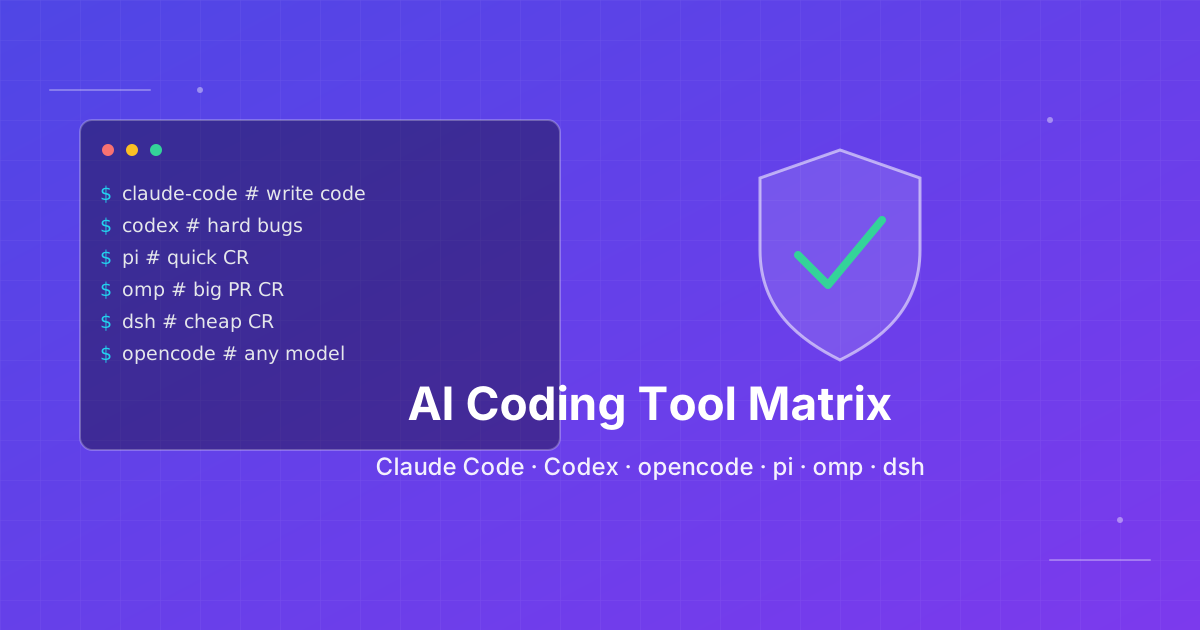
Seven AI Coding CLIs Compared: Tasks, Costs, and Independent Review
Compare Claude Code, Codex CLI, OpenCode, Pi, omp, DeepSeek Harness, and Grok Build with a repeatable task checklist and practical review workflow.