

Command Code
Command Code is a terminal coding agent from Command Code AI, founded by Ahmad Awais. It positions itself as the first frontier coding agent that both builds software and continuously learns your coding taste. Every accept, reject, and follow-up edit becomes a signal for taste-1, a meta neuro-symbolic model that tries to encode how you name things, extract helpers, and structure tests. The product is installed with npm i -g command-code and launched as cmd on macOS, Linux, and WSL, or cmdc on native Windows. The company announced a $5M seed round on its launch page.
Key Features
- taste-1 learning loop: Accepts, rejects, and edits are turned into project-level skills instead of a static rules file.
- Interactive CLI: Slash commands,
!bash mode,@file mentions, plan mode, permissions, memory, agents, skills, MCP, hooks, and git worktrees. - Headless and sandbox modes:
cmd -pand--yolosupport scripted runs; background sandboxing is built in. - Open and frontier models: Claude, GPT, Kimi, DeepSeek, MiniMax, GLM, Gemini, and others, including deal pricing on selected models.
- Team taste sharing:
npx taste push/pullmoves a taste profile across machines and teammates. - Hackable surface: Reusable
/skills,/commands,/mcpservers, plugins, and a/designmode with multiple interface audits.
Use Cases
- Daily coding: Ship features, fix bugs, write tests, and refactor in a style that compounds over time.
- PR review: Use the agent to review diffs faster, then keep the edits that match your taste.
- Open-model harness: The launch post argues that many agents fail with open models because the harness, not the model, is weak.
- Team onboarding: Share a taste profile so a new machine or teammate does not start from generic LLM style.
Pricing
Public pricing on commandcode.ai/pricing (accessed 2026-08-16):
| Plan | Price | Stated credits |
|---|---|---|
| Go | $1/month plus processing fee | $10 credits included, up to about $40 usage with deals |
| GOAT | $10/month plus processing fee | $70 credits included, up to about $100 usage with deals |
| Pro / Max | from $20/month; Max 10x and Max 20x advertised; $100/month Max listed with $150 credits | Open-source plus premium models, higher rate limits |
| Provider API | $15/month plus processing fee, pay as you go, no markup | OpenAI- and Anthropic-compatible endpoints |
| Teams | $40/month plus processing fee | Shared billing and a pooled credit bucket |
| Enterprise | Custom | Org-specific limits and support |
Several model deals were listed on the same date, including 4x DeepSeek V4 Pro through August 16, 2026, 50% off Gemini 3.7 Flash through December 31, 2026, and free Laguna S 2.1 / Ling 3.0 Flash while capacity lasts. Treat those as time-bound promotions.
Getting Started
- Install Node.js 22 or newer. Command Code refuses to start on Node 20 and below.
- Run
npm i -g command-code@latest, thencmd --version(orcmdc --versionon native Windows). - In your project, run
cmdand completecmd login. - Start a task in interactive mode, or use
cmd -pfor a headless prompt. - After a few accept/reject cycles, inspect the generated taste artifacts and optional
/shareflow.
Frequently Asked Questions
How is taste different from a rules file or skill?
Skills and rules are static instructions. Taste is a learned profile: the agent observes what you keep and what you change, then applies that pattern later. Rules decay; the product's claim is that taste compounds.
Does it work on Windows?
Yes. On native Windows the short alias is cmdc because cmd is already the system shell. In WSL the alias is cmd.
Do I have to use Command Code's models?
No. The docs describe Claude, GPT, Kimi, DeepSeek, and other frontier or open models. There is also a $15 Provider API plan for OpenAI- and Anthropic-compatible clients.
Alternatives
- Claude Code: Anthropic's terminal agent, stronger if you already live in the Claude subscription.
- T3 Code: an open-source control surface for several coding agents, including Claude Code and Codex.
- OpenCode: an open coding-agent stack if you want to own the harness.
Tips & Best Practices
- Correct early: the first week of accepts and rejects teaches taste-1 more than a long prompt ever will.
- Keep Node current: the CLI will not start on Node 20, so upgrade before debugging "silent" launch failures.
- Treat deal pricing as temporary: DeepSeek and Gemini promotions expire; budget against the base plan.
Comments
No comments yet. Be the first to comment!
Related Tools


Related Insights

Skills + Hooks + Plugins: How Anthropic Redefined AI Coding Tool Extensibility
An in-depth analysis of Claude Code's trinity architecture of Skills, Hooks, and Plugins. Explore why this design is more advanced than GitHub Copilot and Cursor, and how it redefines AI coding tool extensibility through open standards.
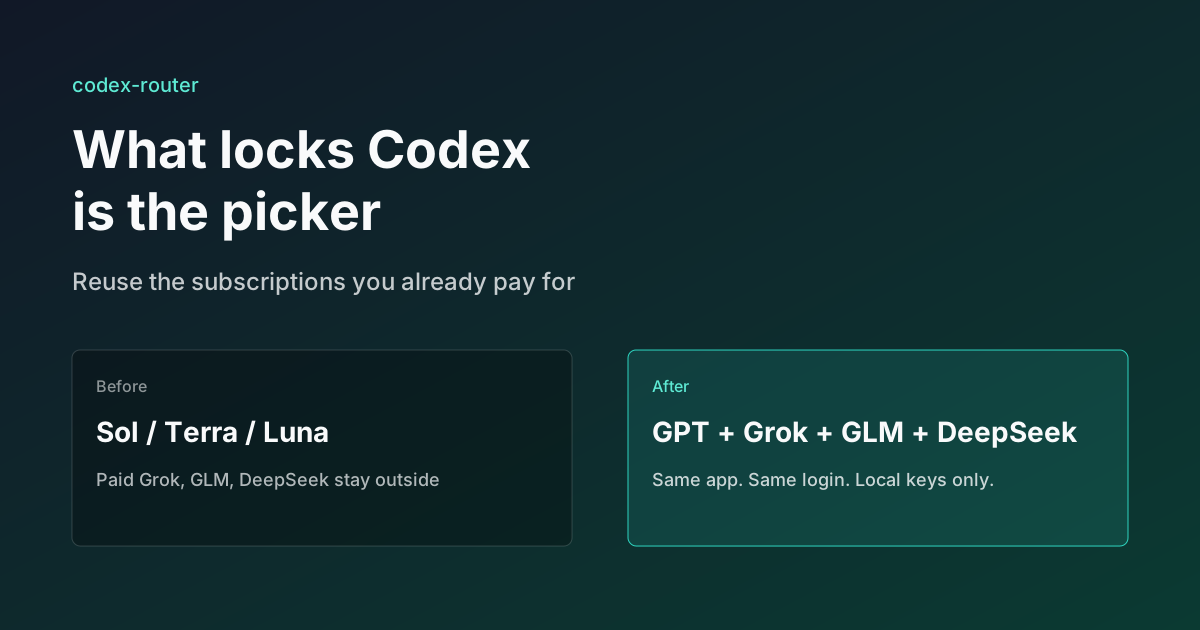
What Locks Codex Is the Picker, Not the Models
You already pay for OpenCode Go, Grok, and Z.ai, but the Codex picker still shows mostly GPT. The community project codex-router does not teach another install ritual. It puts subscriptions you already bought back into the selector, keeps keys on the machine, and leaves native GPT alone.
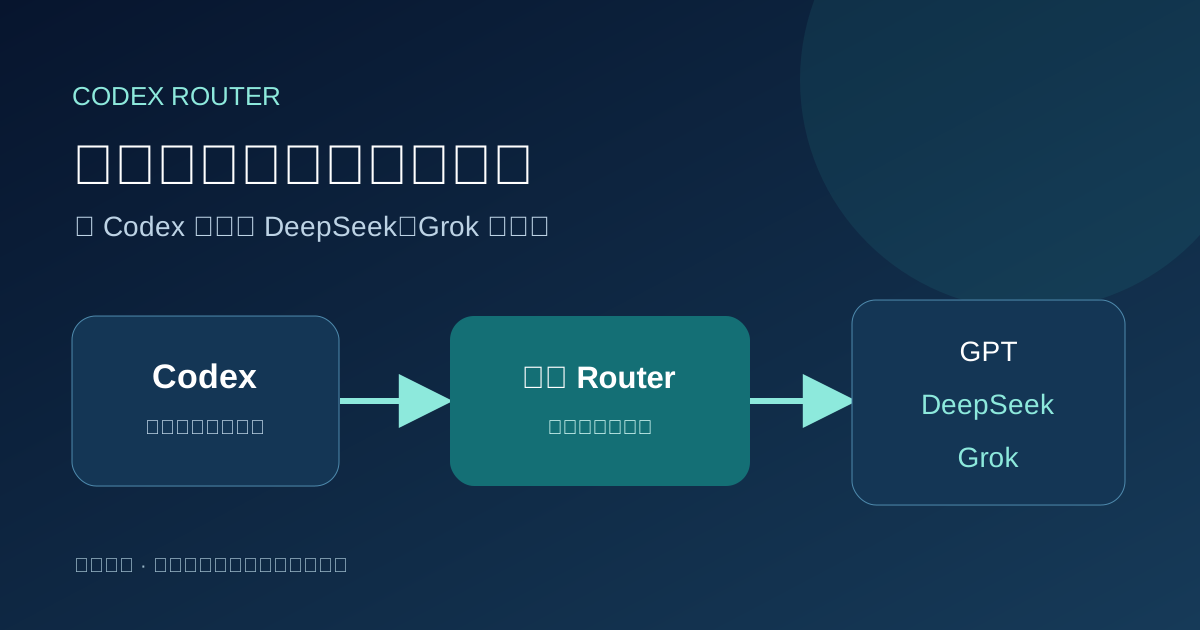
Running low on ChatGPT Codex quota? Switch to DeepSeek or Grok inside Codex
Codex Router lets you keep your Codex workspace while using DeepSeek, Grok, and other external models. A plain-English guide to routing, quotas, and network access.