
Muse Code is Meta's first terminal coding agent, released in beta on August 5, 2026, and powered by the Muse Spark 1.2 model. Announced by Mark Zuckerberg himself, it takes on complete software engineering tasks across large repositories: planning changes, writing code, and validating results. It installs with a single curl command and is designed to be the direct competitor to Claude Code and OpenAI Codex, differentiating on price rather than raw capability.
Key Features
- One-command install:
curl -fsS https://dev.meta.ai/install.sh | bashgets you running on macOS or Linux in seconds. - Persistent background agents: Sub-agents stay alive across the session and maintain a shared context file, so long-running tasks don't lose state.
- Parallel sub-agents in isolated worktrees: Large jobs fan out to separate agents working simultaneously; your working copy is never touched.
- Replay-exact state reconstruction: Every call, edit, and approval is logged, so work survives crashes and can be resumed exactly where it stopped.
- Long-horizon execution: Built for 1,000+ tool calls over up to 24 hours of autonomous work.
- Headless mode:
muse execsupports non-interactive CI pipelines. - 1M token context window: Whole-repo understanding without manual context management.
Use Cases
Who Should Use This Tool?
- Developers on large monorepos: The parallel worktree model shines when a task spans many files and features.
- Teams watching API costs: The Contributor tier is over 10x cheaper than pay-as-you-go, at the cost of letting Meta use your data to improve the model.
- Multi-agent power users: Anyone comparing Claude Code and Codex and wanting a third serious option at a different price point.
Problems It Solves
- Session fragility: Crash-safe event logging means agent work is never lost.
- Repo-scale coordination: Sub-agents in isolated worktrees let several features be built in parallel without collisions.
- Seat-based pricing lock-in: Muse Code is per-token, not per-seat, which changes the economics for heavy users.
Pricing
| Plan | Price | Features |
|---|---|---|
| Contributor | $0.10/M in, $0.20/M out | Cheapest tier; Meta uses your prompts and completions for training |
| Standard | $1.25/M in, $4.25/M out | Private; your data is not used for training |
| Web search | $2.50/1K queries | Optional grounding add-on |
The CLI itself is free; you pay only for model tokens through the Meta Model API. A Contributor tier gets you in at "more than 10 times cheaper than pay-as-you-go," per Meta's Alexandr Wang.
Advantages & Unique Selling Points
Compared to Competitors:
- Price: Roughly 10x cheaper than comparable coding agents when you accept data sharing.
- Recovery: Replay-exact logging is a differentiator versus agents that lose work on crash.
- Scale: Isolated-worktree parallelism handles large repos without touching your working copy.
What Makes It Stand Out:
- Backed by Meta and co-trained with the harness itself using rejection-sampled trajectories.
- Open-weight Muse Glimmer and Muse Spark variants give a path to self-hosting.
- Contributor tier is a genuinely new pricing experiment for coding agents.
User Reviews
The launch generated immediate buzz across X and tech press. Benchmark chatter on Terminal-Bench 2.1 and DeepSWE 1.1 shows Muse Code clustered close behind Claude Opus 5 but ahead of several rivals, while the price difference became the main talking point. Zuckerberg's "I'll have more to share on that soon" reply about open-sourcing sparked its own thread cycle.
Getting Started
Quick Start Guide
- Install: Run
curl -fsS https://dev.meta.ai/install.sh | bash. - Sign in: Authenticate with a Meta account and pick Contributor or Standard.
- Describe a task: Point it at a repo and describe the change in natural language.
- Watch it work: Sub-agents fan out in worktrees; approve edits as they come.
Integration
- Works with any Git repository, large or small.
- Muse Spark 1.2 is also available via OpenRouter and the Meta Model API.
Frequently Asked Questions
Is Muse Code open source?
Not yet. The CLI and model are proprietary; Zuckerberg has hinted at sharing more about open-sourcing soon.
How much does it cost?
The CLI is free. Model usage is per token: from $0.10/$0.20 per million tokens on the Contributor tier to $1.25/$4.25 on Standard.
Does it touch my working copy?
No. Sub-agents operate in isolated Git worktrees; your working copy is never modified.
How does it compare to Claude Code?
Both are terminal coding agents; Muse Code differentiates on price, crash recovery, and 1M-token context, while Claude Code has a longer track record and ecosystem.
Alternatives
If Muse Code isn't the right fit, consider these alternatives:
- Claude Code: Anthropic's terminal agent with a mature ecosystem of skills and hooks.
- Codex CLI: OpenAI's open-source terminal agent, integrated with ChatGPT and the OpenAI API.
- OpenCode: Open-source terminal agent with multi-provider support built in.
Tips & Best Practices
- Try Contributor first: The 10x price cut makes experimentation nearly free; switch to Standard only when data privacy matters.
- Use
muse execin CI: Headless mode turns Muse Code into an automated code-review and fix pipeline. - Let it fan out: For large tasks, describe the whole feature rather than narrow subtasks — parallelism is the strength.
Comments
No comments yet. Be the first to comment!
Related Tools


Related Insights
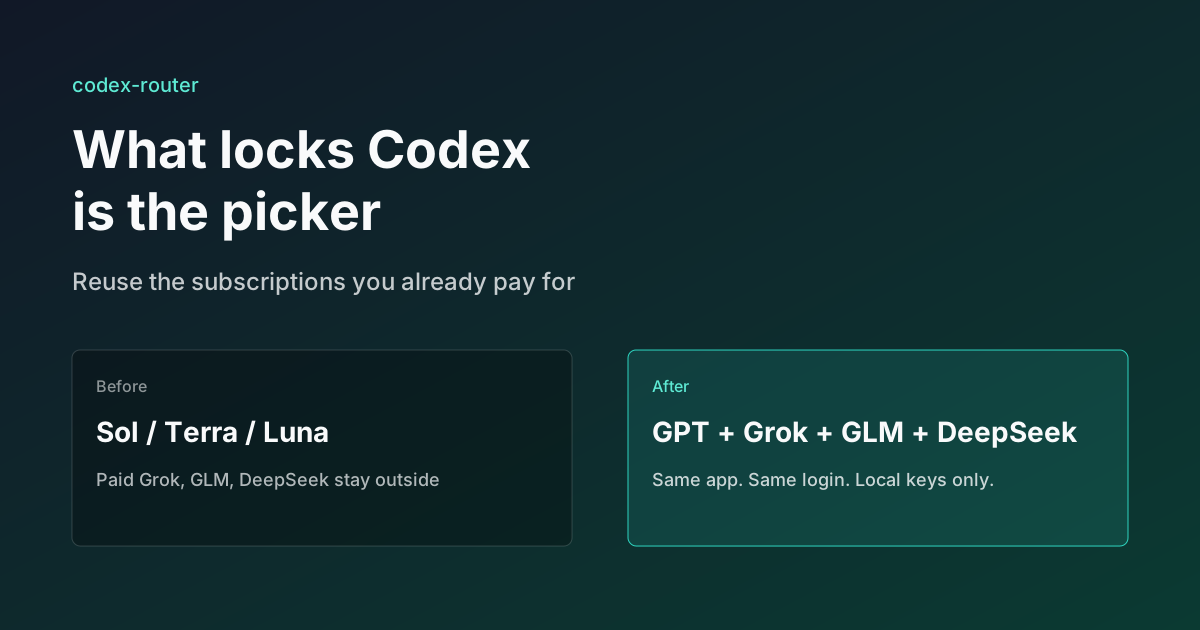
What Locks Codex Is the Picker, Not the Models
You already pay for OpenCode Go, Grok, and Z.ai, but the Codex picker still shows mostly GPT. The community project codex-router does not teach another install ritual. It puts subscriptions you already bought back into the selector, keeps keys on the machine, and leaves native GPT alone.
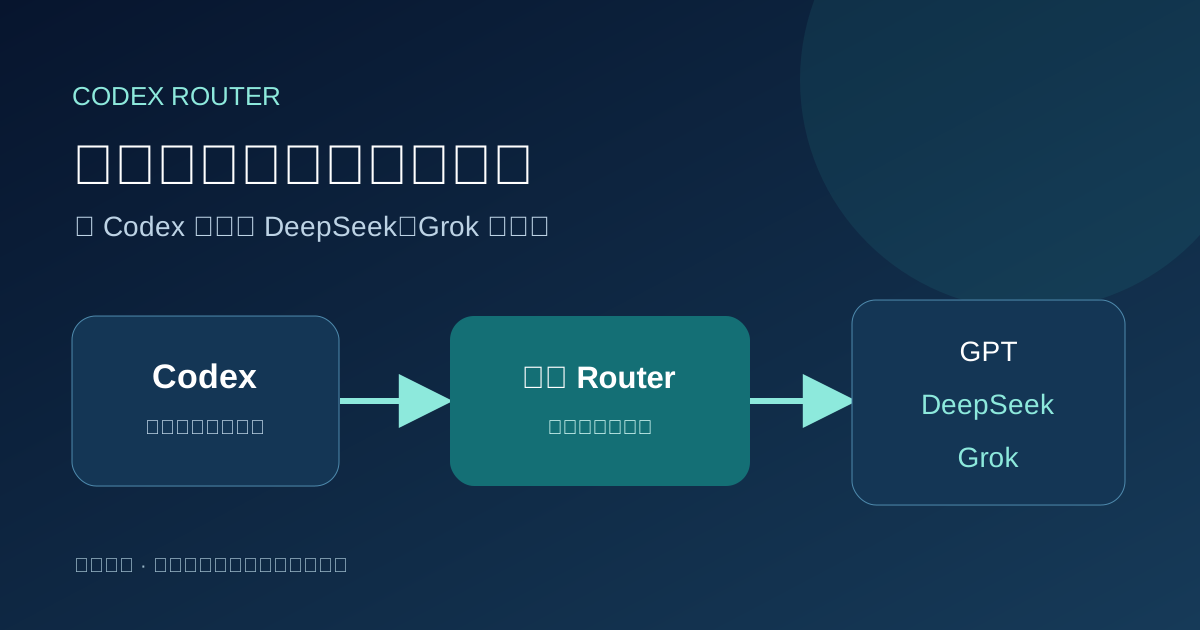
Running low on ChatGPT Codex quota? Switch to DeepSeek or Grok inside Codex
Codex Router lets you keep your Codex workspace while using DeepSeek, Grok, and other external models. A plain-English guide to routing, quotas, and network access.

Skills + Hooks + Plugins: How Anthropic Redefined AI Coding Tool Extensibility
An in-depth analysis of Claude Code's trinity architecture of Skills, Hooks, and Plugins. Explore why this design is more advanced than GitHub Copilot and Cursor, and how it redefines AI coding tool extensibility through open standards.