
Whiteboard
Whiteboard is an open-source desktop app from /dev/fast, launched on Hacker News on 2026-09-24 and built on one observation: reading a diff is no longer how anyone understands a change. The agent made a hundred decisions between your prompt and the commit, and a line-by-line diff preserves none of them. Whiteboard gives the agent a canvas instead.
It connects to the coding agents you already run, including Claude Code and Codex, and exposes an SDK the agent uses to draw on an in-app canvas while it works. You get a sequence diagram of the request path, an entity relationship diagram of the schema change, and a link from any box on the canvas back to the line of code that implements it.
Key Features
- Agent-drawn diagrams: The README pitches Whiteboard as a workspace where humans and agents architect software together. The agent draws the flow, entities, or trace; you point at what is wrong and ask it to redraw.
- Semantic diff viewer: A Rust-based, AST-aware diff that hides test and documentation churn, collapses large added functions into pseudocode, and is extensible through a WASM plugin system. You see the changes that carry behavior.
- Decision log: Agents can query and link their own traces to the canvas, so the requirements you set, the interpretation the agent chose, and the code that resulted sit in one place.
- Code jump and LSP: Clicking a node jumps to the underlying code, and you get VS Code keybindings and language server support out of the box, because Whiteboard vendors Code OSS as its shell.
- Local checkouts: It runs against repositories on your machine. Telemetry is anonymous and excludes prompts, model output, and diffs, and it can be turned off.
Use Cases
- Reviewing a large agent branch where a raw diff is thousands of lines and the useful question is "what did it decide", not "what did it type".
- API and schema changes, where the review is faster on a diagram of endpoints and tables than on a patch file.
- Onboarding to agent-generated code: the canvas plus decision log is a shorter path to understanding than reconstructing intent from commits.
- Architecture discussions: hand the agent a prompt and let it draw the proposed design on the shared canvas before anyone writes code.
Pricing
Whiteboard is free and MIT licensed. There is no account, and the app runs against local checkouts on macOS and Fedora Linux. The project states that a hosted product for teams is planned and that everything will remain self-hostable. The current release at the time of writing is v0.1.2, published 2026-09-24.
Getting Started
- Download the app from install.dev.fast or the Fedora build from install.dev.fast/linux.
- Open Whiteboard and connect Claude Code, Codex, or another coding agent from the welcome screen.
- Ask the agent to review your current branch against main and open the result in Whiteboard, then read the canvas instead of the diff.
The README notes that Whiteboard works well with models such as GPT-6 Sol and Claude Opus 5.5, which is a statement about the quality of the drawn output rather than a hard requirement. Source and a one-minute demo are linked from GitHub.
Limitations and Risks
- You cannot edit files in Whiteboard. It is a review and reasoning surface, not an editor, and the README says so explicitly. Treat it as a viewer that sits beside your editor.
- Single-repo reviews. Working and browsing files across multiple repositories in one review is not well supported.
- Sharing does not stream updates. A shared review is a snapshot; changes made afterwards do not appear for the other person until you re-share.
- It is a young project. Created 2026-08-18, and the release cadence is fast and pre-1.0. The build vendors Code OSS, so expect a large download and periodic upstream merges.
FAQ
Which agents does it work with?
Claude Code and Codex are named in the README quickstart; any agent that can use the SDK can draw on the canvas.
Is my code uploaded anywhere?
Whiteboard runs against local checkouts. Telemetry is anonymous and documented in the repository, and does not include code, diffs, prompts, or model output.
Is it a VS Code fork?
It vendors Code OSS as the editor shell so you get LSP and familiar keybindings, then layers the canvas, semantic diff, and decision log on top.
Does it replace my diff tool?
Not entirely. It replaces the part of code review where you are reconstructing intent; you still need a normal editor for line-level edits.
Alternatives
- Claude Code: the agent side of the loop, if you only need the terminal workflow.
- Codex CLI: OpenAI's terminal agent, also supported as a Whiteboard source.
- Cursor: an AI editor, closer to the editing half of the workflow.
- magpie: route every local agent at any model while you work in Whiteboard.
Tips
- Ask for the diagram and the diff in the same request, so the canvas and the code land together.
- Use the semantic diff defaults for a first pass, then adjust the WASM plugin options if you need tests visible.
- Highlight anything you dislike on the canvas and hand the selection back to the agent rather than describing it in prose.
Conclusion
Whiteboard targets the part of agentic development that tooling has been slowest to address: the gap between a prompt and a merged change, where intent is easiest to lose. If your reviews have turned into scrolling a machine-written diff, an open-source canvas that makes the agent explain itself is worth the install.
Comments
No comments yet. Be the first to comment!
Related Tools


Related Insights
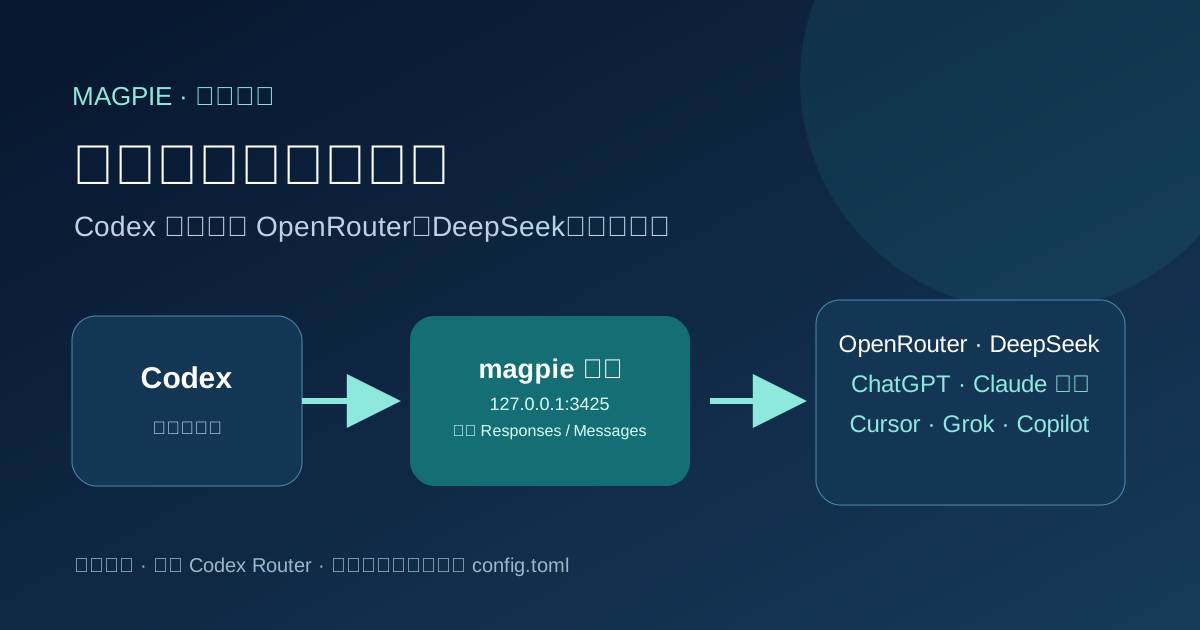
Codex on any model: magpie makes Codex Router unnecessary
magpie is a free, open-source menu bar app that runs a local gateway and puts OpenRouter, DeepSeek and your ChatGPT, Claude, Cursor, Grok and Copilot subscriptions right into Codex's own model picker, with one click and no Codex Router.
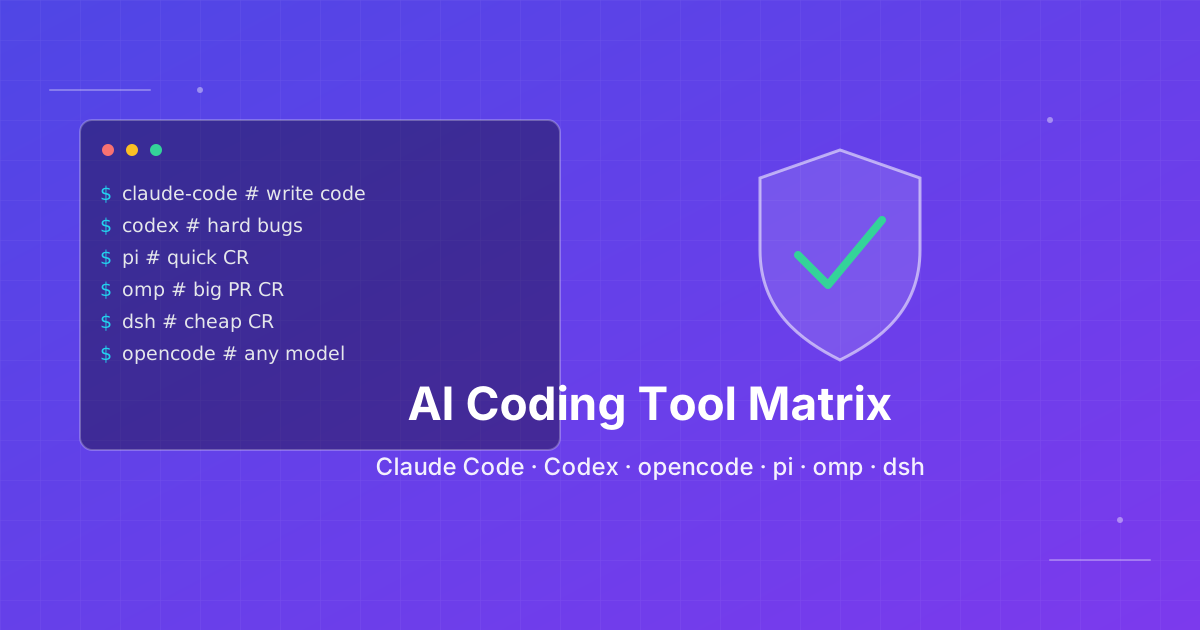
Seven AI Coding CLIs, Six Months: No Matter How Strong the Model, Work Needs Supervision
Claude Code, Codex, opencode, pi, omp and DeepSeek Harness all have personalities. After six months of deep use I run a division of labor: pi for the fastest cheapest reviews, omp for complex PRs, DeepSeek Harness on V4 Flash for high-frequency low-cost review, and Claude Code, Qoder and Cursor for writing. No matter how strong the model, work needs supervision — ideally from an independent third party.

Skills + Hooks + Plugins: How Anthropic Redefined AI Coding Tool Extensibility
An in-depth analysis of Claude Code's trinity architecture of Skills, Hooks, and Plugins. Explore why this design is more advanced than GitHub Copilot and Cursor, and how it redefines AI coding tool extensibility through open standards.