
Qwen 4
Qwen 4 is Alibaba's next-generation flagship model. At the 2026 Apsara Conference in Hangzhou, Alibaba Cloud confirmed that Qwen 4 is currently in training and outlined a roadmap in which the Qwen 4.5 and Qwen 5 series are projected to scale to 5 to 10 trillion parameters. Nothing has shipped yet: there are no published weights, no API endpoint, and no price list. Treat everything on this page as a company roadmap statement rather than a specification you can build against today.
If you need a Qwen model that works right now, Qwen3.8-Max is the current open-weight flagship, and Qwen3.8-Flash-Next is the sparse architecture preview that points at where this generation is heading.
What Alibaba has confirmed
| Item | Detail |
|---|---|
| Announced | September 22, 2026, Apsara Conference (Hangzhou) |
| Status | In training |
| Roadmap | Qwen 4.5 and Qwen 5 projected at 5-10 trillion parameters |
| Weights, API, pricing | Not announced |
| Architecture | Not disclosed; expected to follow the sparse mixture-of-experts direction previewed in Qwen3.8-Flash-Next |
| Companion silicon | T-Head Zhenwu V900, with 216 GB of GPU memory and 1,200 GB/s inter-chip bandwidth |
| Infrastructure target | More than 20 GW of Alibaba Cloud data center capacity by 2032 |
Key features
- A stated scale target, not a spec sheet: Alibaba is the first major lab to publicly project a 5-10 trillion parameter ceiling for its next two generations. Parameters alone say little about quality, but the number signals how much training capacity the company is willing to commit.
- Recursive self-improvement is part of the pitch: Alibaba says a fully automated run of more than a month took Qwen3.8-Max through 33 iterative cycles of pipeline design, data validation, and error diagnosis, lifting its Artificial Analysis score from 40 to 45. In a separate chip design experiment the model ran for over 60 hours and made more than 10,000 EDA tool calls, cutting chip area by 42% on a production-grade bus module.
- A multimodal family around it: the same keynote debuted Qwen3.8-LiveTranslate for simultaneous interpretation, Qwen-Audio-3.1-TTS-Next for cinematic audio generation, and Qwen-Image 3.1 for design and ecommerce imagery.
- Agents as a first-class target: Qwen Intelligence packages the models as a phone-maker agent platform for cross-app tasks, and Alibaba is pairing the roadmap with a purpose-built agentic cloud.
Who should care
- Model watchers: this is the clearest public signal yet that Chinese labs intend to compete at trillion-parameter scale rather than only on efficiency.
- Teams on Qwen today: the roadmap tells you what to expect from the 4.x line, but plan capacity around Qwen3.8-Max until weights appear.
- Anyone comparing frontier options: GPT-6 Astra and Claude Opus 5.5 are shipping, benchmarked, and priced. Qwen 4 is neither.
Availability and pricing
Alibaba has announced no release date, no context window, no modalities, and no pricing for Qwen 4. Historical pattern is the only guide: previous Qwen flagship generations arrived first through QwenCloud and Model Studio APIs, with open weights following for the flagship tier. Do not budget against those assumptions.
Frequently asked questions
Can I use Qwen 4 today?
No. It is in training. Use Qwen3.8-Max or Qwen3.8-Flash-Next for production work.
Will Qwen 4 be open weight?
Unannounced. Alibaba has released open weights for recent flagship tiers, but it has not committed to doing so for Qwen 4.
What does the 5-10 trillion parameter figure refer to?
Alibaba's own roadmap language for the Qwen 4.5 and Qwen 5 series, not for Qwen 4 itself. It is a target, not a measured result.
Alternatives
If you need frontier capability now, compare GPT-6 Astra, Claude Opus 5.5, Grok 4.7, and Kimi K3. For open weights today, Qwen3.8-Max and MiMo-V2.6 are the practical choices.
The honest read: Qwen 4 is a roadmap headline. Track the Apsara announcements, but do not plan a migration around a model that has not left the training run.
Comments
No comments yet. Be the first to comment!
Related Tools

Related Insights

Obsidian CLI + Codex: Turn Your Vault into an Agent Knowledge Engine
Obsidian CLI gives Codex and other agents a searchable, auditable, link-aware interface to a local Vault, using real cases and reproducible workflows.

Grok Bot and Hermes Bot: one person finally gets a think tank and a secretariat
Grok Bot now ships with Cursor Pro+. Hermes Bot runs on a VPS. They are not smarter chat boxes. The think tank advises, the secretariat executes, and you still make the call.
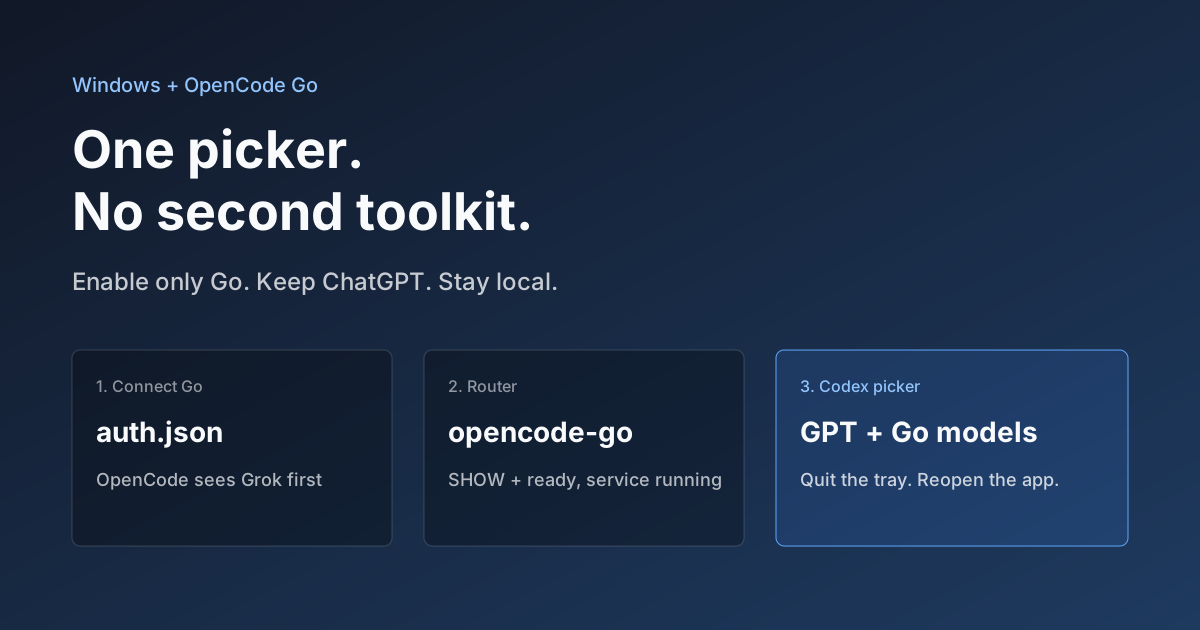
Hook OpenCode Go into Codex on Windows. Do Not Open a Second Toolkit.
A ChatGPT-signed Codex desktop app still shows mostly GPT in the picker. On Windows, enable only OpenCode Go and the Grok, GLM, Kimi, DeepSeek, and MiniMax models you already pay for appear in the same selector. Keys stay local. Native GPT stays put.