

Food Database Query
Food Database Query is a Claude Code skill from WellAlly Health (formerly Claude-Ally-Health), an MIT-licensed, local-first personal health record project maintained by WellAlly Tech. It gives the project's nutrition commands a local food composition table: look up a food, compare two foods, find foods high or low in a nutrient, and total up a meal you describe in plain language.
Reference data, not dietary advice. Values are per 100 g of raw or standard-cooked food, and real intake varies with cooking, portion, and individual absorption. For medical diets, work with a registered dietitian.
The database
- Size. 50 common foods in version 1.0 (created 2026-01-06), each with more than 30 nutrient fields: calories, macronutrients, vitamins, and minerals.
- Sources. The metadata cites the China Food Composition Tables (6th edition) and USDA FoodData Central.
- Structure. 10 categories and more than 30 subcategories in
food-categories.json, a standard portion per food, English names, and aliases (for example oats, rolled oats, and 燕麦片 all map to the same entry). - Reference intakes. A separate file holds recommended daily intakes for adult men and women aged 19 to 50, used to show how a food or meal compares with daily needs.
All three files live in the repository's data-example/ folder, with a maintenance guide for adding foods.
What it does
- Food lookup with nutrition facts, highlights, health labels, and a suggested portion.
- Comparison of two foods nutrient by nutrient, with a recommendation.
- Recommendations by nutrient, filtering foods above or below a threshold (for example high-fiber foods).
- Meal calculation. Parses input like "oatmeal 1 cup + egg 1 + milk 250ml", matches each item to the database, converts portions, and totals the nutrients.
- Smart search across names and aliases, with fuzzy matching and category browsing.
How to use it
WellAlly Health is a Claude Code project, not a standalone package. Clone it and start Claude Code in the folder:
git clone https://github.com/huifer/WellAlly-health.git
cd WellAlly-health
claude
The skill is used through the /nutrition command. Examples adapted from the upstream docs (food names there are in Chinese; English names and aliases are also stored):
/nutrition food salmon
/nutrition compare chicken-breast salmon
/nutrition record breakfast oatmeal 1 cup + egg 1 + milk 250ml
Limitations
- With 50 foods, many dishes and packaged products are missing. The upstream roadmap plans to expand coverage.
- Nutrient values differ by region, variety, and preparation.
- It does not account for individual conditions such as kidney disease or allergies unless you check those separately.
FAQ
Is it an online food API? No. It reads local JSON files, so lookups work offline, though the analysis itself runs through Claude Code.
Can I add my own foods? Yes. The repository includes a food database maintenance guide describing the JSON structure.
Alternatives
- Nutrition Analyzer: the diet analysis skill that uses this database, from the same project.
- Goal Analyzer: tracks diet goals built on these numbers.
- Health Trend Analyzer: relates diet records to symptoms and weight over time.
Browse more in the skills category or the health tag.
Comments
No comments yet. Be the first to comment!
Related Tools


Related Insights

Anthropic Subagent: The Multi-Agent Architecture Revolution
Deep dive into Anthropic multi-agent architecture design. Learn how Subagents break through context window limitations, achieve 90% performance improvements, and real-world applications in Claude Code.
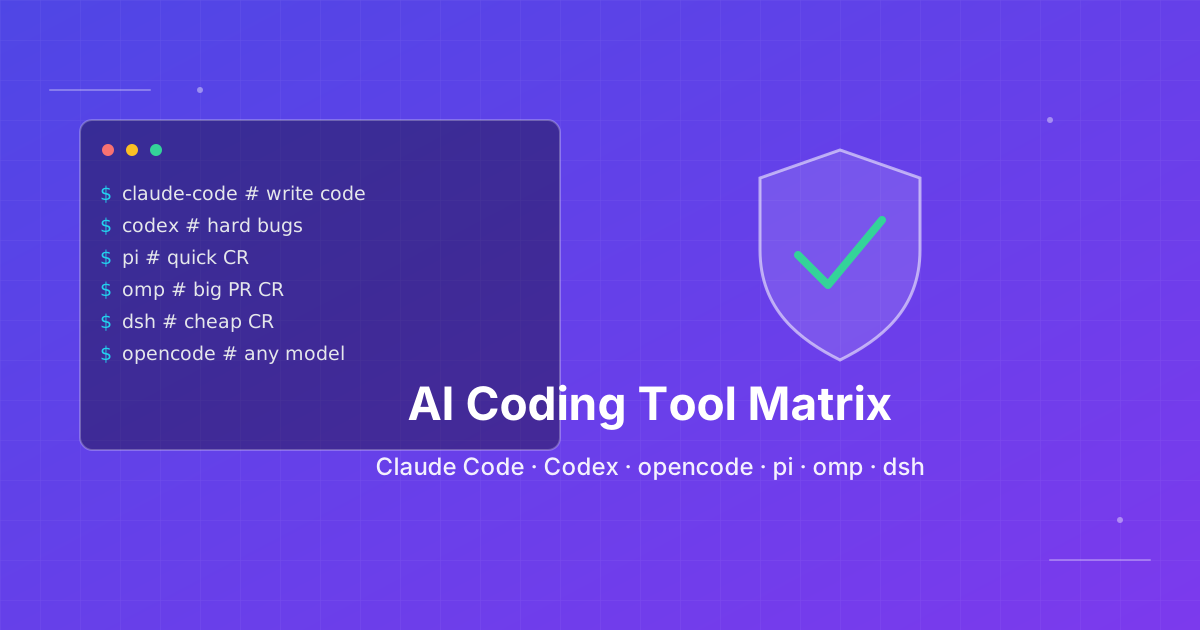
How to pick an AI coding CLI for your repo
Match Claude Code, Codex CLI, OpenCode, Pi, omp, DeepSeek Harness, and Grok Build to the work you actually run. Docs rechecked 2026-10-06.

Skills + Hooks + Plugins: How Anthropic Redefined AI Coding Tool Extensibility
An in-depth analysis of Claude Code's trinity architecture of Skills, Hooks, and Plugins. Explore why this design is more advanced than GitHub Copilot and Cursor, and how it redefines AI coding tool extensibility through open standards.