

Health Trend Analyzer
Health Trend Analyzer is a Claude Code skill from WellAlly Health (formerly Claude-Ally-Health), an MIT-licensed, local-first personal health record project maintained by WellAlly Tech. It answers the question "how has my health changed?" by reading everything else the project has recorded (profile, symptoms, mood, diet, medication logs, lab results) and looking for trends, turning points, and correlations over a chosen time window.
Data insights, not medical advice. The skill does not diagnose, recommend specific medication, or predict prognosis, and every report is marked as for reference only. Take concerning trends to your doctor.
What it analyzes
- Weight and BMI over time.
- Symptoms. Recurring complaints, changes in frequency, and possible triggers.
- Medication adherence. Missed-dose patterns per medicine.
- Lab results such as cholesterol, blood glucose, and blood pressure against their reference ranges.
- Mood and sleep, and how they move together.
- Correlations. Whether a new medication lines up with a change in symptoms, how diet and sleep relate to symptoms and mood, whether a treatment coincides with improvement, and cycle-related patterns for users who track them.
- Change detection. Rapid weight change, new symptoms, worsening or improving patterns, and alerts near thresholds (for example BMI extremes or cumulative radiation dose).
Under the hood the skill file specifies linear-regression trend detection, Pearson and Spearman correlation, and change-point methods such as CUSUM. Correlation is not causation, and the report should be read that way.
How to use it
WellAlly Health is a Claude Code project, not a standalone package. Clone it and start Claude Code in the folder:
git clone https://github.com/huifer/WellAlly-health.git
cd WellAlly-health
claude
There is no dedicated command. Log data with the project's other commands (/symptom, /mood, /diet, /medication, /save-report for lab reports), then ask in plain language, for example "analyze my health trends over the past 6 months" or "is my new medication related to my headaches?" The default window is the last three months.
Output
A concise text report in the terminal, and a standalone HTML report with interactive ECharts charts: an overview card, a weight and BMI chart, symptom frequency, a medication adherence gauge, lab trends with reference lines, a correlation heatmap, and mood and sleep over time. The HTML is print-friendly and can be shared with a doctor. Its chart libraries load from a CDN, so viewing it needs an internet connection.
Limitations
- Trends need enough data points. With sparse records, the skill will say the analysis is limited.
- It only sees what you have logged, and self-reported symptoms and mood are subjective.
FAQ
Does my data leave my machine? Records are stored as local files. The analysis runs through Claude Code, so the content you ask about is sent to the model Claude Code uses.
Which skill should I start with? This one is most useful after a few weeks of logging with the other WellAlly commands.
Alternatives
- AI Health Analyzer: cross-module analysis with risk prediction, from the same project.
- Mental Health Analyzer: deeper mood and mental health tracking.
- Sleep Analyzer: focused sleep quality analysis.
Browse more in the skills category or the health tag.
Comments
No comments yet. Be the first to comment!
Related Tools


Related Insights

Anthropic Subagent: The Multi-Agent Architecture Revolution
Deep dive into Anthropic multi-agent architecture design. Learn how Subagents break through context window limitations, achieve 90% performance improvements, and real-world applications in Claude Code.
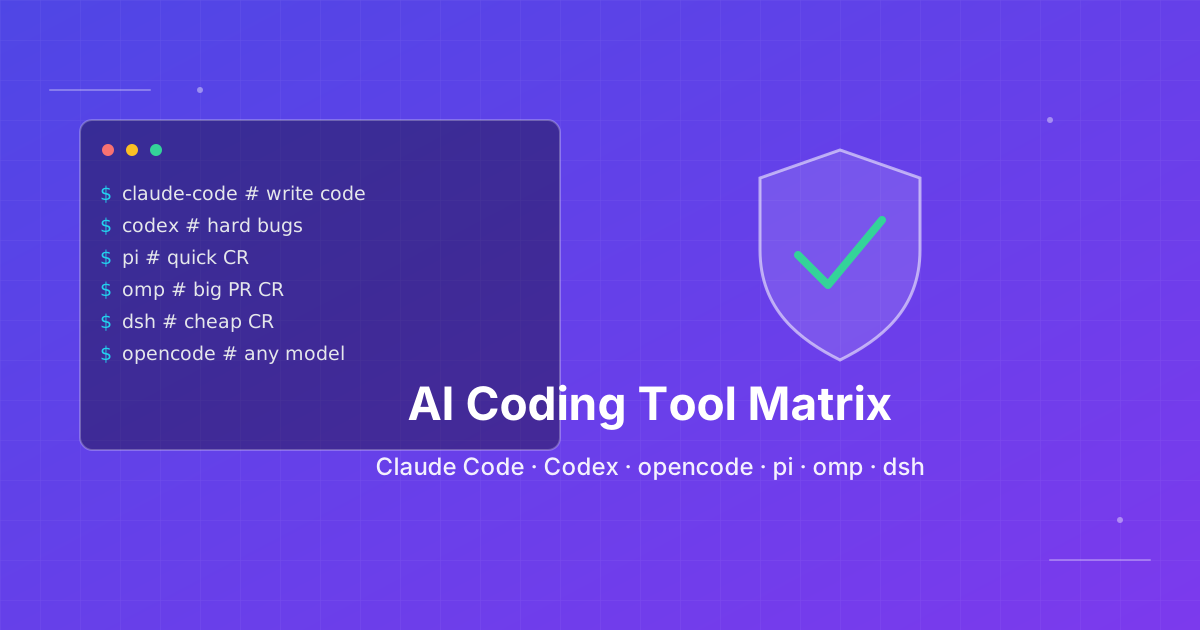
How to pick an AI coding CLI for your repo
Match Claude Code, Codex CLI, OpenCode, Pi, omp, DeepSeek Harness, and Grok Build to the work you actually run. Docs rechecked 2026-10-06.

Skills + Hooks + Plugins: How Anthropic Redefined AI Coding Tool Extensibility
An in-depth analysis of Claude Code's trinity architecture of Skills, Hooks, and Plugins. Explore why this design is more advanced than GitHub Copilot and Cursor, and how it redefines AI coding tool extensibility through open standards.