

Spec Kit
Spec Kit is an open source toolkit from GitHub for Spec-Driven Development (SDD). Instead of treating a spec as disposable scaffolding, it makes your specification the source of truth that drives checklists, task breakdown, and eventually the implementation itself. It is a process plus a thin CLI (specify) that works with the agent you already use, so you keep control of the what and the why while the agent does the rest.
Compare Specboard if you want a visual board and MCP server on top of specs, Plandex for a terminal plan-and-execute agent, or Claude Code for Anthropic's first-party agent.
Key Features
- Executable specifications: the spec, plan, and tasks are living artifacts the agent actually reads, not documents you file away.
- Six guided phases: constitution, specify, plan, tasks, implement, and converge. You drive the agent through each checkpoint and repeat till converge reports "Converged".
- Specify CLI:
specify init <project> --integration <agent>bootstraps a project, plus self-management commands such asspecify self checkandspecify self upgrade. - Bring your own agent: slash commands surface as
/speckit-*in Claude Code and Copilot,$speckit-*in skills mode, and are addressable in any prompt. - Extensions: an opt-in bug extension (assess, fix, test) and an assess extension (intake, research, define, shape, decide) for vetting ideas before commitment.
Use Cases
Who Should Use This Tool?
- Teams building with agents: onboard a coding agent the way you would onboard a junior engineer, with docs and a backlog instead of guesswork.
- Developers tired of context loss: keep the product intent in versioned Markdown so each session starts from the same place.
- Technical leads: review small, focused tasks rather than thousand-line code dumps, and record architectural rules once.
Problems It Solves
- Vibe coding drift: a spec gives the agent an explicit target, so output matches intent instead of generic patterns.
- Restarting from scratch: persistent artifacts survive across sessions, days, and months.
- Security and standards as afterthoughts: constraints are baked into the spec and plan from day one.
Pricing
Spec Kit is free and MIT licensed. You run the specify CLI yourself and keep the small cost of agent tokens from whichever provider you use.
Advantages & Unique Selling Points
- Agent-agnostic: no lock-in; the same process works across Claude Code, Copilot, Gemini CLI, and Codex.
- Process first, tooling second: the innovation is the workflow, and the CLI stays lightweight behind it.
- Community-driven: presets, extensions, and role-based bundles shape the project, not a single vendor.
Getting Started
- Install the CLI:
uv tool install specify-cli. - Initialize:
specify init my-project --integration copilot. - Launch your coding agent in the project directory.
- Run
/speckit-constitution, then/speckit-specify,/speckit-plan,/speckit-tasks, and/speckit-implement; loop/speckit-convergeuntil it reports Converged.
Frequently Asked Questions
Does it work with the agent I already use?
Yes. It targets Claude Code, GitHub Copilot, Gemini CLI, and Codex, and the slash commands are addressable from any agent prompt.
Is it a subscription or a hosted service?
Neither. It is an MIT open source toolkit you run locally; there is no hosted runtime or per-seat fee.
What is Spec-Driven Development, in one line?
You define what to build before building it, and the specification, plan, and tasks become the inputs that guide and check the agent's work.
Alternatives
- Specboard: visual board and MCP server for agent-readable specs.
- Plandex: terminal plan-and-execute agent with a diff sandbox.
- Claude Code: Anthropic's first-party terminal agent.
Tips
- Write a short constitution once per project so every session inherits the rules.
- Use the bug extension to keep fixes evidence-based from root cause to verification.
- Re-run
/speckit-convergedeliberately; it is the checkpoint that keeps implementation aligned with intent.
Conclusion
Spec Kit brings engineering discipline to agentic development by making the specification the source of truth. If your agent keeps drifting or losing context, start at github.com/github/spec-kit and let the process, not the prompt, do the steering.
Comments
No comments yet. Be the first to comment!
Related Tools


Related Insights

Skills + Hooks + Plugins: How Anthropic Redefined AI Coding Tool Extensibility
An in-depth analysis of Claude Code's trinity architecture of Skills, Hooks, and Plugins. Explore why this design is more advanced than GitHub Copilot and Cursor, and how it redefines AI coding tool extensibility through open standards.
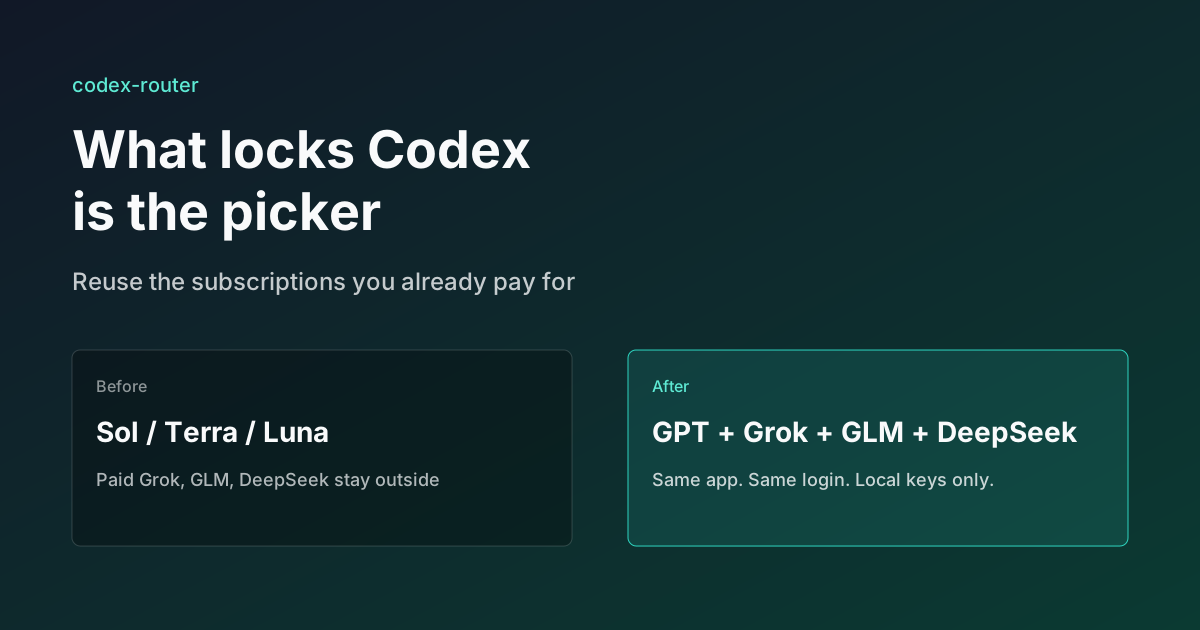
What Locks Codex Is the Picker, Not the Models
You already pay for OpenCode Go, Grok, and Z.ai, but the Codex picker still shows mostly GPT. The community project codex-router does not teach another install ritual. It puts subscriptions you already bought back into the selector, keeps keys on the machine, and leaves native GPT alone.
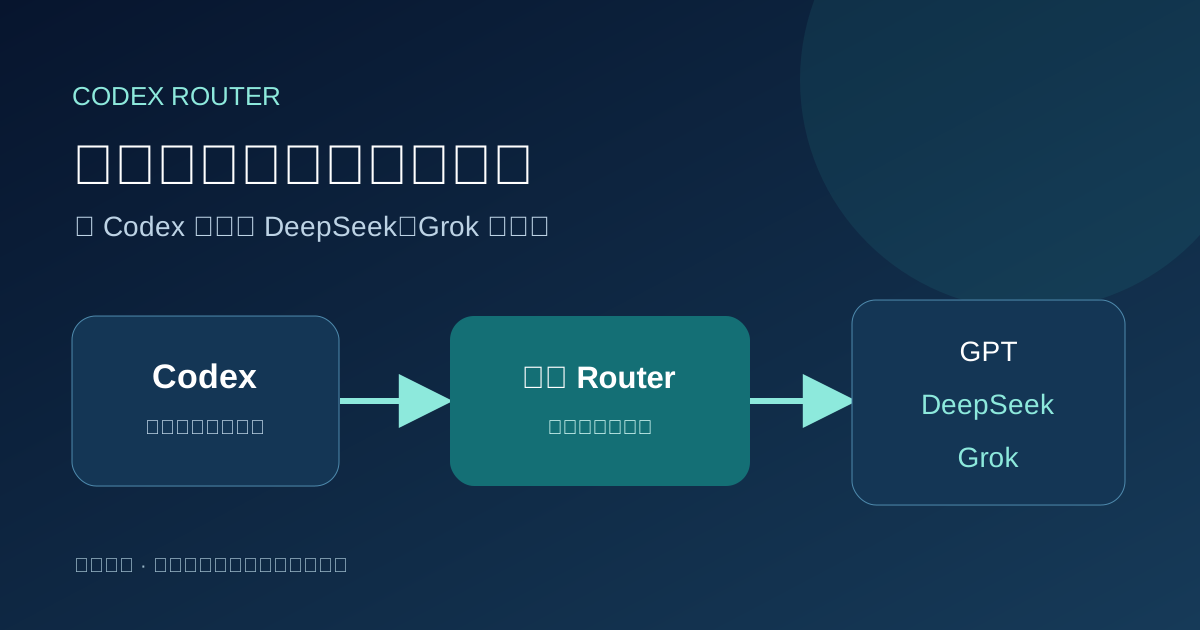
Running low on ChatGPT Codex quota? Switch to DeepSeek or Grok inside Codex
Codex Router lets you keep your Codex workspace while using DeepSeek, Grok, and other external models. A plain-English guide to routing, quotas, and network access.